


RPET Vs Virgin PET: How To Choose The Right PET Preform
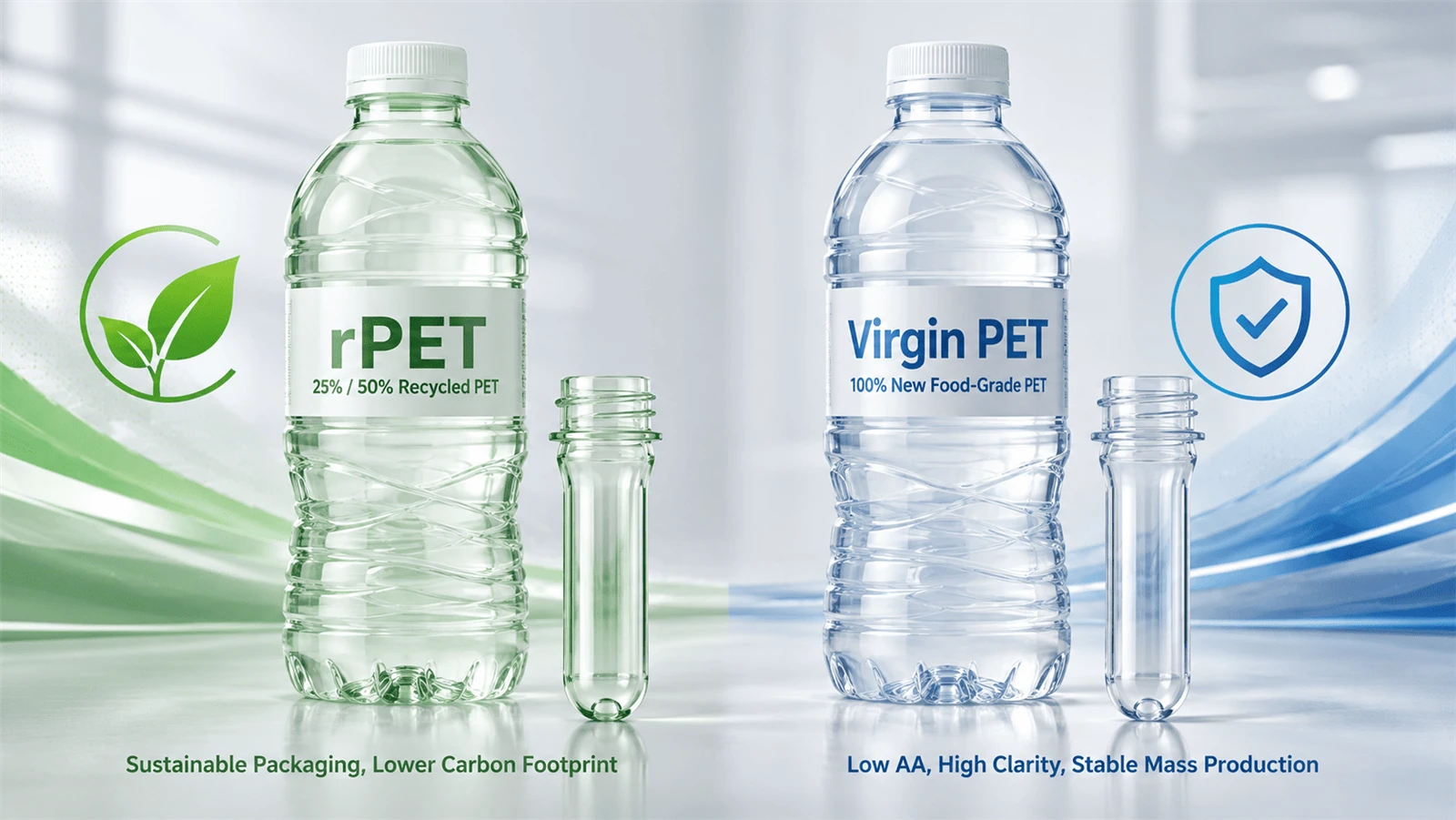
Many beverage brands, filling plants, and bottle factories now need to choose between rPET preforms and virgin PET preforms. rPET can help reduce virgin plastic use, but buyers still need to check color, black spots, AA level, and bottle blowing stability.
Virgin PET is often easier to control for clear bottles and stable mass production. rPET can be a strong choice when Your Company needs recycled content, but the right option still depends on the bottle type, filling method, target market, and production line.
1. Why Buyers Compare rPET and Virgin PET
In the past, many buyers chose PET preforms by neck finish, weight, color, price, and delivery time. Now the material source has become more important. Buyers often ask whether the preform can use rPET, how much rPET can be added, and whether the material is suitable for food-contact packaging.
This change comes from brand ESG goals, market rules, and customer requirements. For many bottle brands, recycled content is no longer only a marketing point. It can affect supplier selection, packaging approval, and long-term purchasing plans.
But buyers should not only ask for a recycled content number. A PET preform still needs to become a bottle through heating, stretching, and blowing. If the material is not stable, the final bottle may show haze, black spots, weak bottle strength, poor cap sealing, or a lower blowing yield.
So the real question is not "Is rPET good?" The better question is: does rPET fit your bottle, your line, your target market, and your quality standard?
2. Virgin PET and rPET: Main Differences
Virgin PET preforms are made from new bottle-grade PET resin. Because the material has not been recycled before, it is easier to keep batch quality consistent. It also makes it easier to control clarity, AA (acetaldehyde), impurities, and overall production stability.
For drinking water, mineral water, and other clear beverage bottles, virgin PET is still a reliable choice. Low AA helps protect water taste, while high clarity and stable weight support smooth production on high-speed bottle blowing lines.
rPET preforms are made from recycled PET bottles or flakes that have been sorted, cleaned, and reprocessed. They help reduce virgin plastic use and support sustainable packaging, but their quality depends on the recycled material, cleaning process, and rPET content.
Different rPET sources can affect color, clarity, black spots, IV, AA, and bottle blowing performance. For food and beverage packaging, buyers should also check the recycling source, food-contact compliance, migration test reports, and target market requirements.
In short, virgin PET gives easier quality control, while rPET helps meet recycled content goals. The right choice depends on your bottle, your production line, and your target market.
|
Item |
Virgin PET Preform |
rPET Preform |
|
Material source |
New bottle-grade PET resin |
Reprocessed recycled PET |
|
Clarity |
Easier to keep clear |
Depends on rPET grade and ratio |
|
Color |
More stable between batches |
May have light color change |
|
Black spots |
Easier to control |
Needs stricter inspection |
|
AA control |
Better for low-AA water bottles |
Must be tested for water and food use |
|
IV stability |
Easier to control |
IV retention needs checking |
|
Blowing performance |
Wider processing window |
Sample blowing is recommended |
|
Sustainability value |
Higher virgin plastic use |
Reduces virgin plastic use |
3. Will rPET Affect Preform Quality?
Many buyers first worry about appearance. They ask whether rPET preforms will look yellow, cloudy, or dirty. This is a practical concern because water bottles and beverage bottles are seen directly by end users.
rPET does not always look yellow. The result depends on the recycled material grade, cleaning process, purification level, rPET ratio, and color control. A 25% or 50% rPET blend is usually easier to keep close to the look of virgin PET. A 100% rPET preform needs stronger raw material control and stricter batch inspection.
Some buyers also worry that rPET cannot run on fast bottle lines. This is not always true. The key is not only the word "rPET." The key is IV, AA, moisture, drying conditions, injection stability, and the blowing test result.
rPET can be more sensitive during production. The factory may need to adjust drying conditions, heating settings, and blowing parameters. For buyers, the safer step is to test samples first. Check the bottle clarity, strength, cap sealing, and actual blowing yield before a large order.
rPET is also not always cheaper. Food-grade rPET needs collection, sorting, washing, purification, reprocessing, and testing. Its price can change with recycled material supply, oil price, food-contact testing, and local market rules. So rPET should be seen as a sustainable packaging choice, not just a cheap material.
4. Match Material to Bottle Use
Different bottles need different preform performance. A water bottle, carbonated drink bottle, hot fill bottle, large water bottle, and shampoo bottle do not have the same material needs.
Water bottles need high clarity, low AA, and clean taste. If your company uses a high-speed water line, virgin PET is often the more stable starting point. It is suitable for mineral water, purified water, natural water, and clear bottled water. If the target market asks for recycled content, 25% rPET can be a safer first test.
Carbonated drink bottles need pressure resistance, strong cap sealing, and good CO2 retention. The material choice should not only focus on recycled content. Buyers also need to check IV, bottle base strength, neck finish, cap system, and sample blowing results. Export projects may also need PCO 1881, PCO 1810, or a custom drawing.
Hot fill bottles are used for juice, tea drinks, functional drinks, and some sauce drinks. These bottles need stable neck shape, low shrinkage, and stable capacity after hot filling. rPET can be tested for these projects, but the buyer should check filling temperature, bottle design, migration test, and target market rules first.
Large water bottles and 5 gallon water bottles need impact strength, stable neck quality, and safe transport performance. These preforms are heavy, and the final bottle carries more load. No matter whether you choose virgin PET or rPET, sample blowing, water filling, and drop testing are important.
Cosmetic and personal care bottles give rPET more room to work. Shampoo bottles, detergent bottles, hand wash bottles, and personal care bottles usually have lower food-contact pressure. These products can accept more color difference than clear water bottles. If the brand wants a greener packaging image, 25% or 50% rPET is a practical option to test first.
5. How Much rPET Content to Choose
The best rPET ratio is not always the highest ratio. Buyers need to match the ratio with the product use, appearance standard, target market, and production line.
- A 25% rPET preform is suitable for brands that want to start with sustainable packaging but still need low production risk. This ratio is easier to test for water bottles and beverage bottles. It can help the buyer observe color, black spots, bottle strength, and blowing yield with less risk.
- A 50% rPET preform is suitable for brands with a clear sustainability target. It gives stronger recycled content value than 25% rPET, but it also needs better control of color, clarity, and raw material stability. Before mass production, buyers should check COA, food-contact documents, sample blowing results, and batch consistency.
- A 100% rPET preform is suitable for customers with a mature rPET supply chain, clear market rules, and strict test requirements. It is not the best choice for projects that only want the lowest price. For food and beverage use, 100% rPET must be checked carefully for recycling source, purification process, migration test, and target market approval.
Enlightening Pallet can supply PET preforms with 25%, 50%, and up to 100% rPET content. For food-contact use, the target market rules should be confirmed before production.
6. Quality Checks Before Ordering
No matter which material you choose, quality checks are necessary. Stable mass production depends on raw material control, preform dimensions, blowing results, and complete documents.
- The first check is raw material quality. Buyers should ask whether the supplier checks IV, AA, moisture, and color value. IV affects stretch strength and pressure resistance. AA affects water taste. Moisture can cause PET degradation and weak preforms.
- The second check is preform dimensions. Preform weight, wall thickness, neck size, thread quality, and support ring size all affect bottle blowing. Unstable weight can affect cost and bottle strength. An inaccurate neck finish can cause cap sealing problems and leakage.
- The third check is the final test and export documents. For food-contact packaging, buyers should ask for COA, migration test, third-party food-contact report, and batch inspection data. For rPET projects, buyers should also check recycled content and material traceability.
7. Custom and Wholesale PET Preforms
Many buyers do not only need a standard preform. They may need a special neck finish, target weight, bottle capacity, color, packaging method, or document set for their market. In this case, custom support is important.
Enlightening Pallet can provide PET preform solutions based on bottle type, capacity, neck finish, weight, and color. Standard colors include clear and light blue. Green, amber, white, and other custom colors can also be made for specific projects. Custom molds, private labeling, and custom packaging can also be discussed based on the order details.
Wholesale buyers also care about stable supply. Water plants, beverage factories, bottle blowing companies, and packaging suppliers need steady batches and clear delivery plans. Standard items can move faster. Custom projects can start with samples and bottle blowing tests before mass production.
8. Certificates and Supplier Reliability
PET preforms are not normal plastic parts. They affect food, beverage, and drinking water packaging. Buyers should not only compare price. They should also check factory control, test reports, and compliance documents.
For food-contact products, FDA, EU 10/2011, and GB 4806.7 are often requested by customers. These documents help buyers check whether the material can be used for the target product and target market.
Factory certificates also matter. ISO 9001, ISO 14001, CE, SGS, and related reports can support customer audits, import checks, internal quality review, and long-term supplier approval. For rPET projects, documents are even more important because buyers need to prove recycled content and food-contact suitability.
9. Final Advice
The choice between virgin PET and rPET is not about which material is always better. It is about which material fits your product, market, and production line.
Virgin PET is often better for high clarity, low AA, and stable mass production. rPET is better for brands with recycled content targets, ESG plans, and sustainable packaging needs. If your project is new to rPET, start with 25% or 50% rPET and test the bottle first.
Contact us for professional solution evaluation. Please send your bottle capacity, neck finish, target weight, virgin PET or rPET ratio, filling method, target market, annual quantity, and destination port. Common Neck Finishes include 28mm, 29/25, 30/25, 38mm, 48mm, and 55mm. Enlightening Pallet can evaluate a more suitable PET preform solution based on your bottle type and production line requirements.
FAQ
1. Can rPET preforms be used for food packaging?
Yes, but the rPET must be food-grade and suitable for the target market. Buyers should check the recycling source, purification process, migration test, and food-contact report.
2. Is rPET preform cheaper than virgin PET preform?
Not always. rPET price can change with recycled material supply, purification cost, food-contact testing, and oil price. Food-grade rPET may cost more than expected.
3. What rPET content can you supply?
Enlightening Pallet can supply 25%, 50%, and up to 100% rPET preforms. Food-contact projects need a rule check before production.
4. Can PET preform color and size be customized?
Yes. PET preforms can be customized by bottle type, neck finish, capacity, weight, color, and sample design.
5. Are 55mm PET preforms only for 20L bottles?
No. A 55mm PET preform is mainly used for 18.9L and 20L water dispenser bottles. It can also be used for some large returnable water bottles, but it is not suitable for small bottle water lines.
