


Is Your Bulk Container Setup Holding You Back? Learn The 2025 Fixes
Why 90% of buyers eventually need modifications
Even the best standard containers can't cover every storage or handling need. That's why most companies turn to modifications-especially in 2025 when flexibility matters more than ever.
In real-world operations, mismatched container dimensions often lead to wasted cube space inside trucks or warehouses. If your product doesn't fit well, you're shipping air instead of goods-and paying for it.
At production lines, poor container access slows down loading and unloading. Operators must reach awkward angles, increasing the risk of repetitive stress injuries and reducing efficiency.
Another trigger is cost. In 2025, the price of new injection molds has surged. For non-standard cargo, investing in new tooling for just a few hundred units is financially impractical. Modification gives you the function of a new mold-without the massive upfront expense.
We're seeing this trend spike across industries. Auto parts, electric components, and agricultural produce all have unique dimensions or handling needs. Modification helps tailor a solution without reinventing the wheel.
The 4 Most Common Plastic Bulk Container Modifications in 2025
Most buyers don't start with modifications, but these four upgrades have become near-standard across industries dealing with non-uniform goods or automated handling systems.
Height Adjustment: More Fit, Less Waste
Many bulk loads either leave unused space inside tall containers or overflow from shallow bins. Adjusting container height-by extending or trimming the sidewalls-ensures the internal volume matches your cargo. For dense goods, reduced height improves loading safety and weight distribution. For lighter but bulky items, height extensions reduce the need for double stacking.
Full-Side Doors: Faster Access, Safer Lines
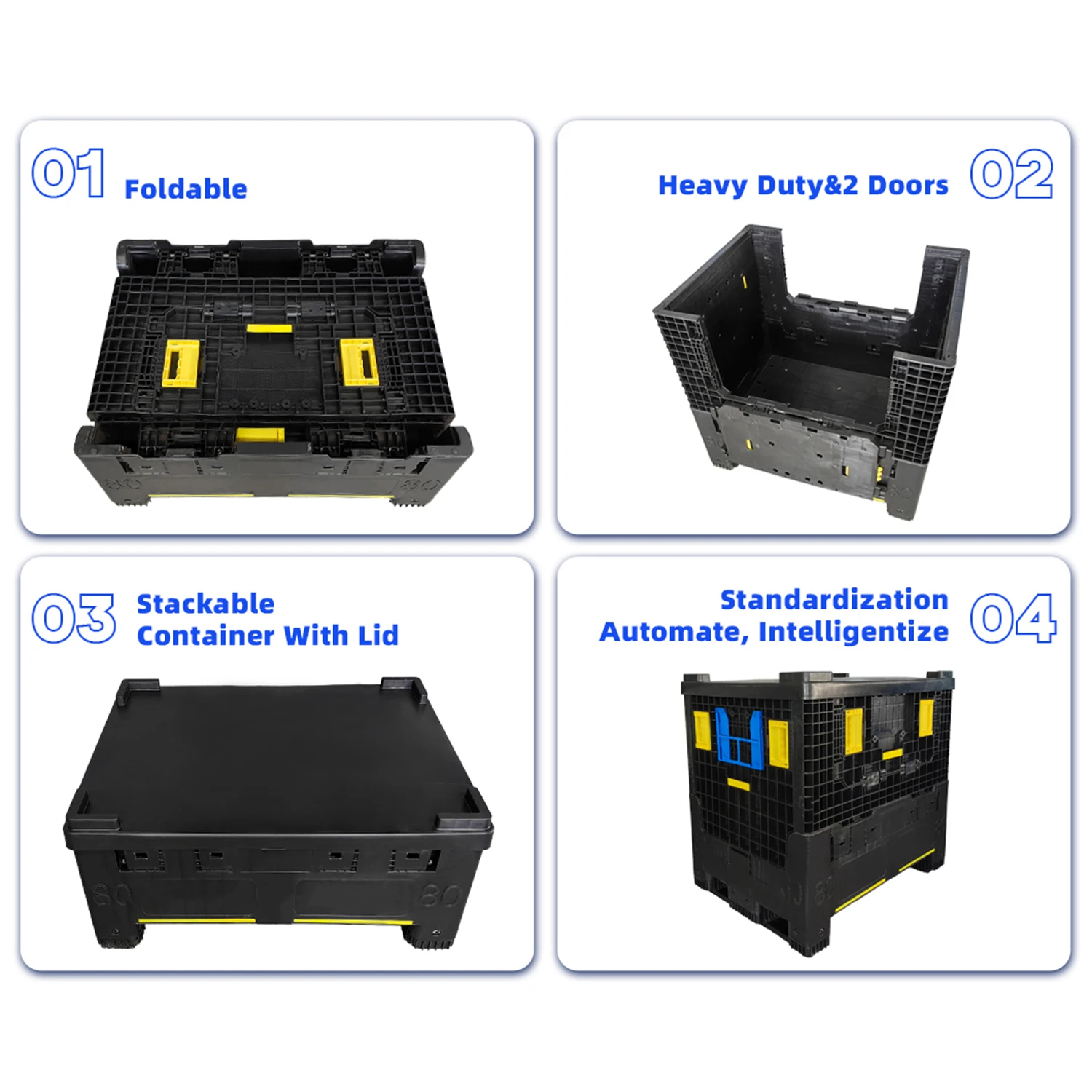
Standard half-drop doors often block forklifts or limit manual access. In modified designs, we integrate full-side openings with secure locking systems. These allow quick side loading, reducing time at each station and minimizing handling risks-especially for fragile, awkward, or heavy parts.
Caster Systems: Mobility Without Repacking
Fixed containers can slow down your line-side operations. Adding integrated casters means containers roll directly from storage to assembly lines without the need for forklifts or trolleys. Most use reinforced corner mounts to prevent deformation. It's a simple upgrade, but one that transforms handling efficiency.
RFID & IoT Panel Reserve: Upgrade-Ready Infrastructure
As more supply chains go digital, having space for RFID or sensor modules is no longer a nice-to-have-it's essential. We pre-design panel zones for smart tracking devices, so your containers are ready for automation upgrades anytime. This avoids future structural changes and fits into most existing asset tracking platforms.
Supplement: Key Specs You Should Track
- Fold height variance: Typically increases 5–10 cm depending on design.
- Internal volume range: After mod, varies ±10–25% compared to standard.
- Load-bearing testing: Each modification passes ISO 8611 or equivalent dynamic/static load test before release.
Will modifications ruin your current racking and stacking setup?
Even small design changes may disrupt your current warehouse system. Let's explore where compatibility issues arise and how to prevent them.
Compatibility matrix: standard vs. modified pallets
Modifications such as thicker walls, rounded corners, or custom fork entry may sound minor. But they can shift load distribution, affect racking tolerances, or misalign stacking contact points.
For example, standard 1200×1000 mm pallets with 4-runner bottoms are often designed to match 1100×1100 shelving grids or 4×4 stacking blocks. Once you switch to oversized base plates or anti-slip feet, the pallet may sit unevenly or fail to interlock as intended.
To assess compatibility risks early, we typically simulate fit based on your existing racking model. Below is a simplified matrix:
| Modification Type | Stacking Fit | Racking Fit | Comments |
|---|---|---|---|
| Standard 4-runner | ✓ | ✓ | Matches most 4×4 rack frames |
| Anti-slip pad (6 mm) | △ | ✓ | Slight lift, may offset nest points |
| Raised deck rim (+15 mm) | ✓ | △ | Needs deeper beam cradle |
| Thicker walls (5 mm+) | ✓ | ✓ | May add ~3–4 kg weight per unit |
| Rounded leg corners | △ | △ | May reduce contact area under load |
✓: Compatible △: Partial fit - test needed
4×4 stacking/racking performance table by mod type
Stacking and racking tolerance is tightly linked to how well pallet feet engage with one another or with beam surfaces. Any deviation in height, surface texture, or load-bearing pad size can break the system.
| Pallet Modification | Max Stacking Height (4×4) | Max Rack Load (Dynamic) | Notes |
|---|---|---|---|
| None (standard model) | 6 layers (2.4 m) | 1,000 kg | Full compatibility |
| Add anti-slip pad | 5 layers (2.0 m) | 1,000 kg | Slight reduction in stack grip |
| Add raised rim | 4 layers (1.6 m) | 800 kg | Rim absorbs partial top load |
| Material: HDPE → PP | 6 layers (2.4 m) | 750 kg | Slightly lower flex resistance |
Cautions for static vs. dynamic load distortion risks
Some buyers overlook that static loads (e.g., stacked pallets at rest) and dynamic loads (e.g., pallets in motion on racks or forklifts) create very different stress conditions.
Under static load, minor base modifications may not pose a problem. But during movement, uneven feet or softer contact points can lead to tilt, torsion, or even collapse. This is especially relevant for tall stacked configurations or for rack-only warehouses.
If you're using selective racking, push-back racks, or shuttle systems, always request a custom stress simulation before approval. We offer digital load modeling based on your rack drawings to ensure each modified pallet remains structurally safe throughout the handling cycle.

90-second modification decision tree
Sometimes the best choice is to modify what you already have. But not always-and not blindly. This section helps you decide quickly.
Start with one simple question: Is your current plastic container fully functional and structurally intact? If yes, move forward. If not, repair or replace is your only safe path.
If the container is structurally sound, check the usage gap. Are you changing how the container is used-adding heavier loads, stacking higher, moving via forklift more often, or shipping further distances? These shifts can all stress the design beyond its original intent.
Now, match your situation to one of the four solution routes:
- Route A: Standard use, minor label or color update only - no structural change.
- Route B: Upgrade for branding or better logistics (e.g., RFID, lid types) - non-load-bearing mods only.
- Route C: Adapt for moderate load increase or new stacking config - requires load test & structural approval.
- Route D: Unsuitable for modification - replace with a new container designed for your new use.
If you're unsure where your case fits, it's safer to start at Route D and work backward with supplier guidance. This prevents overconfidence in structural margins and avoids expensive downstream failures.
The "hidden 5th modification" 99% of suppliers won't offer
When everyone talks about reinforcement and load testing, one critical upgrade often gets left out. And yet, for agriculture and cold-chain logistics, it can make all the difference.
We're talking about built-in drainage and ventilation systems. In containers used for fresh produce or temperature-sensitive goods, standing water and poor airflow can degrade product quality or even cause spoilage. A simple integrated vent panel or sloped base with a drain plug can solve this, but it requires mold-level tooling changes-not something most off-the-shelf suppliers are ready to support.
Another rarely mentioned upgrade is deep groove lids or internal protective linings. These features reduce internal abrasion when transporting granular or sharp-edge materials like seeds, grains, or frozen cuts. It keeps packaging damage low and product presentation intact, which is crucial in export shipments.
Why don't suppliers bring this up? Because these are not standard mold add-ons. They require new tooling or post-process changes. But if you're working with sensitive cargo, ignoring these options could lead to silent losses-damage you don't discover until delivery.
Conclusion
Modification isn't about complexity-it's about control. You already have the containers. Now it's time to make them work smarter.
Even minor changes-like vented sides or reinforced corners-can help avoid recurring damage, reduce freight costs, or meet new client specs. If you delay, waste, product loss, or capacity issues will likely continue stacking up. Fast upgrades now prevent expensive overhauls later.
If you're unsure what to adjust, don't guess. Our container engineers will review your current inventory, identify the fastest and lowest-risk improvements, and help you define a clear upgrade path tailored to your logistics setup. Let's optimize what you already own.

