


Recycling Bin Colours Explained: What Does Each Colour Mean?
Recycling bin colours can make waste sorting easier, but different places use different colour systems. Knowing the common meanings helps me avoid confusion when choosing or using recycling bins.
Recycling bin colours are commonly used to identify different waste streams, but their meanings are not universal. Blue is often linked to recycling or paper, yellow is commonly used for recycling in some regions, and brown is often associated with organic waste. Local collection rules should always take priority.
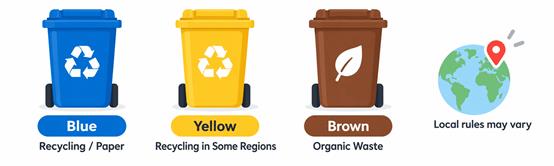
When I work with waste bins, I treat colour as a visual guide rather than a worldwide standard. The same colour can represent different waste types in different countries or municipalities. Labels, recycling symbols, and local collection rules are also important.
What Do Different Recycling Bin Colours Mean?
I find that most people want a simple answer: what should go into a bin of a certain colour? The answer depends on the local waste collection system, but some colour associations appear more often than others.
Blue bins are commonly associated with recycling or paper, yellow bins are often used for recyclable packaging, brown bins are commonly linked to organic waste, and black or gray bins are often used for general waste. Other colours can have different meanings depending on the location.
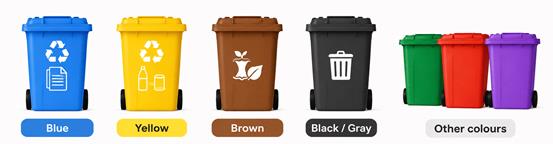
|
Bin Colour |
Common Meaning |
Important Note |
|
Blue |
Recycling or paper |
The exact materials vary |
|
Green |
Organic or general waste |
Local systems differ |
|
Yellow |
Recycling or packaging |
Common in several regional systems |
|
Brown |
Food or organic waste |
Often used for compostable materials |
|
Red |
General or special waste |
Meaning varies by location |
|
Black / Gray |
General or residual waste |
Common for non-recyclable waste |
|
Purple |
Glass |
Used in some local systems |
|
White |
Special waste |
Not a universal colour code |
I use these meanings as general guidance, not as a legal sorting standard. If I am selecting bins for a commercial or municipal project, I first check the requirements of the local waste authority.
Blue, Green, and Yellow Bins
I commonly see blue used for recycling or paper and cardboard, and plastic recycling wheelie bins with colour lids can make these categories easier to identify. Some programs use one blue bin for several recyclable materials, while others use it specifically for paper.
Green can indicate organic waste or general waste. I therefore do not assume that every green bin has the same purpose.Yellow is often associated with recycling and packaging. In some systems, it is used for mixed recyclable materials. Australia is one example where yellow is widely used for recycling.
Brown and Red Bins
Brown is commonly linked to food and organic waste. It can be used for food scraps, garden waste, or other organic materials when separate collection is available.Red needs more attention because its meaning changes between systems. In Australia, red is commonly used for general waste, while red containers can have other meanings in specific healthcare or hazardous waste settings.
Black, Gray, Purple, and White Bins
Black and gray are often associated with general or residual waste. Purple can be used for glass in some local systems. White may be used for special waste in specific programs.
I recommend using a clear label with any less common colour. Colour alone can create confusion when users are unfamiliar with the local system.
What Are the Recycling Bin Colour Codes in Different Countries?
I do not use one colour chart for every country. Waste collection systems are usually established at the national, regional, or municipal level, so the same colour can have different meanings.
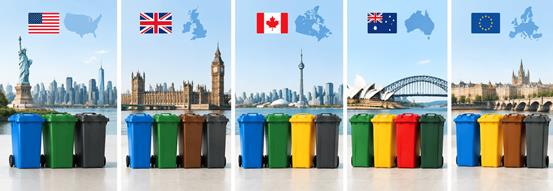
The United States and United Kingdom have significant local variation, Canadian systems can differ between municipalities, Australia has a more defined colour approach for mobile waste containers, and Europe does not have one single colour system for every country.
United States
In the United States, blue is commonly used for recycling, while black or gray often indicates general waste. Green or brown may be used for organic waste. I always check local recycling bin rules before choosing colours.
01
United Kingdom
In the UK, recycling bin colours vary between local councils. Blue may indicate recycling, green garden waste, and black general waste. I recommend checking the local council's requirements before selecting bin colours.
02
Canada
Canadian recycling bin colours vary by municipality. Toronto, for example, uses a Blue Bin for recycling and a Green Bin for organic waste. I check the specific municipal system rather than applying one national colour code.
03
Australia
Australia has a clearer colour system for mobile waste bins. Red commonly indicates general waste, yellow recycling, lime green organics, and blue paper and cardboard. I still confirm local requirements before production.
04
Europe
Europe has no single recycling bin colour system. Blue is often linked to paper, brown to organic waste, and green to glass in some areas. I match bin colours and labels to the specific country or municipality.
05
Are Recycling Bin Colours Standardized Worldwide?
I do not treat recycling bin colours as a worldwide standard. Different waste management systems use different colours based on local collection methods, waste categories, infrastructure, and public policies.
There is no universal recycling bin colour code for every country. Local collection rules should take priority, while clear labels and recycling symbols can make the system easier to understand.
I find that colour works best as part of a complete identification system. For example, a yellow bin can indicate recycling, but a recycling symbol and a label such as "Mixed Recycling" give users more useful information.
This becomes more important in offices, schools, shopping centres, factories, and public areas. Many people may use the same bins, and they may not know the local colour system. Simple labels can reduce incorrect sorting and contamination.
How Do Colour-Coded Bins Improve Waste Sorting?
I use colour coding because it gives people a quick visual way to identify different waste streams. A consistent system can make sorting easier when several bins are placed together.
Colour-coded bins help users recognize waste categories, support source separation, reduce confusion, and make recycling instructions easier to follow.
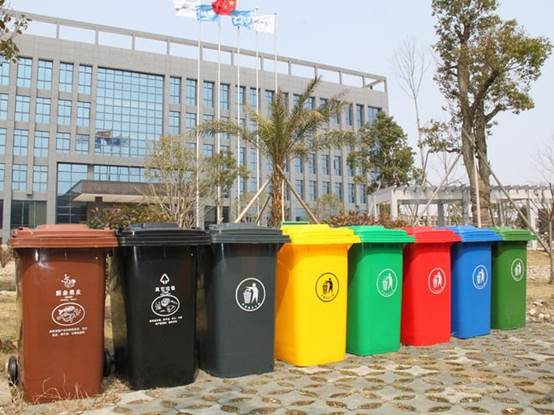
When I plan a waste collection area, I usually keep the same colour and label for the same waste category throughout the site. This creates a simple system that workers, customers, students, or visitors can learn quickly.
Colour also helps businesses create clearer waste stations. A recycling bin placed next to a general waste bin can use different colours and labels to guide users before they dispose of their waste.
For larger projects, I also consider the bin's capacity, lid design, mobility, and collection method. A good colour system needs suitable containers behind it.
Where Can Colour-Coded Recycling Bins Be Used?
I see colour-coded bins used in both public and commercial environments. The right setup depends on the waste streams, collection frequency, available space, and local regulations.
Colour-coded bins can be used in municipal collection, commercial buildings, schools, hospitals, public areas, events, and industrial facilities when the colours and labels match the local waste-sorting system. For medium-volume collection, a 240L recycling wheelie bin can be suitable for commercial and public recycling areas.
In offices and commercial buildings, colour-coded bins can separate recycling, general waste, and food waste. Schools and universities can use simple colours and symbols to make sorting easier for students and staff.
Municipal and industrial projects usually have more specific requirements. I check the required capacity, material, lid structure, wheel configuration, and collection equipment before recommending a bin.
For outdoor applications, I also consider weather exposure and frequent handling. Wheeled plastic waste bins can be useful when collection teams need to move containers regularly.
How Should I Choose Colour-Coded Bins for a Project?
I start with the waste categories, not the colour. Once I know what materials the customer needs to collect, I check the local rules and then select the colour, label, capacity, and bin structure.
I recommend checking local regulations first, matching each bin with a specific waste category, adding clear labels or symbols, selecting the right capacity, and confirming compatibility with the planned collection equipment.
Check Local Requirements
I first confirm where the bins will be used and what waste streams need to be separated. This prevents a common purchasing mistake: following a general online colour chart that does not match the local collection program.
01
Match the Bin to the Waste Stream
After confirming the requirements, I assign each colour to a specific waste category. I keep the system consistent across the project so users do not have to learn different meanings in different areas.
02
Add Labels and Symbols
I recommend adding recycling symbols, waste names, or other clear markings. This is especially useful when a colour has different meanings in different countries.
03
Select the Right Capacity
I choose the capacity based on waste volume and collection frequency. Smaller bins can suit indoor waste stations, while larger wheeled plastic waste bins are more suitable for outdoor collection and higher waste volumes.
04
Check Handling Requirements
I also check how the bin will be moved and emptied. Wheel size, lid design, dimensions, and lifting compatibility can all affect the final product choice.
05
Can Colour-Coded Plastic Waste Bins Be Customized?
I often work with buyers who need specific colours to match local waste rules, company standards, or municipal projects. In these cases, customization helps keep the entire waste collection system consistent.
Colour-coded plastic waste bins can be customized with different colours, labels, logos, capacities, and lid configurations, depending on the product and project requirements.
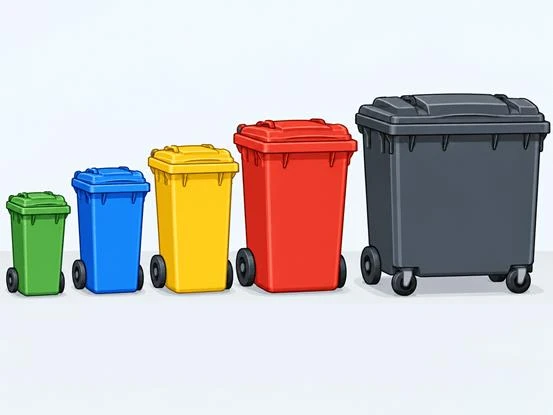
At Enlightening Pallet, I can support bulk projects that require custom colours, logos, labels, and different bin sizes. Our plastic waste bins are available for commercial, industrial, and waste collection applications.
For projects with specific colour requirements, I recommend confirming the target market, waste categories, required colours, quantity, and collection method before production. I can then help match the bin configuration with the actual operating conditions.
Samples can also be arranged before a bulk order. Buyers can contact Enlightening Pallet to discuss colours, labels, dimensions, and equipment compatibility.
FAQ
Q: What does the colour of a recycling bin mean?
A: A recycling bin colour usually identifies a specific waste stream, but the exact meaning depends on the local waste collection system.
Q: Are recycling bin colours the same in every country?
A: No. Countries, municipalities, and waste operators can use different colour systems, so local collection rules should always be checked.
Q: What colour bin is commonly used for recycling?
A: Blue and yellow are commonly associated with recycling in different regions, but the exact colour depends on the local program.
Q: What colour bin is commonly used for food waste?
A: Brown is often used for food or organic waste, although green and other colours may be used in some local systems.
Q: Can plastic waste bin colours be customized?
A: Yes. Bulk projects can often specify custom colours, labels, logos, and other product details based on the product design and order requirements.
Q: Should businesses follow local bin colour regulations?
A: Yes. Businesses should follow the waste-sorting requirements that apply to their location and use clear labels when colour alone could cause confusion.
Conclusion
I treat recycling bin colours as a visual guide, not a universal rule. The safest approach is to follow local requirements and combine colour with clear labels and symbols.
