


Best Plastic Crates For Grapes: Storage And Transport
Grapes go through a lot after they leave the vine. Picking, stacking, pre-cooling, and transport all put stress on the fruit, and grapes don't handle stress the way apples or oranges do. If the crate is too deep, poorly vented, or rough on the inside, you end up with crushed berries and uneven cooling before the load even reaches the buyer.
The short answer is this: a good plastic crate for grapes comes down to ventilation, internal depth, wall texture, stacking strength, and how easy the empty crate is to handle afterward. Capacity matters less than most buyers assume
Why Grapes Need the Right Crate
Grapes aren't like solid fruit. A bunch is made up of dozens of berries, and when you pack them too deep, the ones at the bottom carry the weight of everything above. Given enough time, that pressure can split the skin and start juice leakage before the fruit even reaches processing.
There's also the cooling problem. Freshly picked grapes carry field heat, and if it doesn't escape quickly, respiration speeds up, sugar and moisture drop faster, and shelf life shrinks. A crate isn't just a container here. It needs to move air, support stacking, and keep the fruit intact at the same time.
This is why a generic storage bin often falls short for grapes. Once you understand what the fruit needs, the selection criteria below make a lot more sense.
What Makes a Plastic Crate Work for Grapes
Ventilation
Side walls and the base need vent holes spread out evenly, not clustered in one spot. Even airflow speeds up field heat removal and keeps pre-cooling and cold storage effective.
If vents are too sparse or bunched together, grapes in the middle of the crate stay warmer than the ones near the edges. Look at hole placement, not just hole count.
Internal Depth
A bigger crate isn't automatically a better one. Shallower crates mean fewer layers of grapes stacked on top of each other, and that means less pressure on the fruit at the bottom.
The smarter move is picking depth based on the grape variety and its end use, not chasing the largest volume per crate. Going too deep almost always costs you quality, even if it saves a bit on crate count.
Smooth Walls and Rounded Corners
Smooth interior walls and rounded edges reduce friction between the berries and the crate. This matters a lot for table grapes, where buyers notice broken skin or loose berries right away.
Rough surfaces or sharp vent edges tend to nick the skin during handling, and that's usually where rot starts.
Stacking Strength
When crates are stacked full, the weight should rest on the crate structure, not on the grapes underneath. Corners and rims need enough strength to keep the load off the fruit below.
It's worth asking suppliers for stack-load test data before ordering in bulk. That's a better way to judge crate strength than eyeballing the wall thickness.
Material: PP or HDPE
Polypropylene, or PP, holds up better under high-heat washing, which suits regions where crates get sanitized at high temperatures. HDPE handles cold-impact resistance better, so it fits cold chain transport where crates get knocked around at low temperatures.
Both materials work fine for agricultural crates. What matters more is build quality, wall thickness, and rated operating temperature, not just the resin listed in the spec sheet.
Types of Plastic Crates for Grapes

The section above covered evaluation criteria. This one covers crate structure, a separate question. Structure decides whether empty crates save space and how fast they cycle through a supply chain.
Ventilated stackable crates are the basic fixed-frame design. They don't fold, and they stack on their own rigid structure. This build is simple and relatively low-cost, which makes it the default choice for most stages, especially when you don't need to compress empty crates often.
Stack-and-nest crates rely on a 180-degree rotation. Full crates stack upright, and once rotated, empty ones nest inside each other to save space. They save more storage room than fixed stackable crates, and without a hinge to manage, they're simpler to handle than folding crates.
Collapsible plastic crates use a hinge system to fold flat when empty, usually cutting volume to a third or a fifth of a fixed crate. The longer the return trip, the more that advantage pays off. But hinges are moving parts, and under repeated heavy loads they tend to wear out before the crate body does. Ask suppliers for hinge fatigue data specifically, not just the load rating for an unfolded crate.
Solid plastic crates skip vent holes entirely. They fit stages that don't need active cooling, like short indoor transfers or storage where dust and pests are the concern. Using a solid crate during pre-cooling or cold storage slows heat loss noticeably, and that's a detail buyers often miss.
Before picking a type, figure out whether your stage needs empty-crate compression or active airflow. Those two questions decide the right type more than price comparisons do.
Matching Crates to Each Stage of Grape Handling
At the vineyard picking stage, weight, handles, and crate height matter most. Workers carry these crates all day, so one built purely for maximum capacity slows the harvest down.
At the packhouse and pre-cooling stage, vent hole density and consistent sizing become the priority. Crates need air channels once stacked, and they should move easily through washing and sorting lines.
In cold storage, structural stability at low temperatures is the key concern. Crate dimensions also need to fit pallets and handling equipment, or you'll lose usable storage space.
For road and cold chain transport, stacking stability and space efficiency matter most. Crates sized to standard pallets improve container loading rates and cut down on wasted cargo space.
On the empty return trip, folding or nesting crates earn their keep. Over long distances, a collapsible design shrinks empty volume, lowering both freight and storage costs.
Choosing the Right Crate Size
Size shouldn't be picked by liters alone. Check external dimensions, internal dimensions, internal height, expected load weight per crate, and how the crates stack together.
If your warehouse already runs on pallets, confirm the crate footprint lines up with the pallet surface. Standardized sizing cuts down on wasted pallet space and slots into existing logistics systems without extra adjustments.
Quick reference:
- Shallow, small-capacity crates: table grapes, hand-picked harvests
- Mid-size ventilated crates: packhouses, pre-cooling, distribution
- Nesting crates: high-frequency circular routes
- Collapsible crates: long-distance empty returns
Table Grapes vs. Wine Grapes
Table grapes need to look good on arrival, since appearance and cluster integrity drive buyer decisions at retail. Shallow crates, smooth walls, and stable stacking all protect that appearance during handling.
Wine grapes typically move fast from vineyard to winery. Picking speed, transport distance, and turnaround per load matter more here than appearance, since that's not the priority once grapes reach the crusher.
Because the end use differs, "the best crate" means something different for each one. Nail down the end use before locking in a crate type and size, and the rest of the decision gets easier.
Plastic Crates vs. Cardboard and Wood
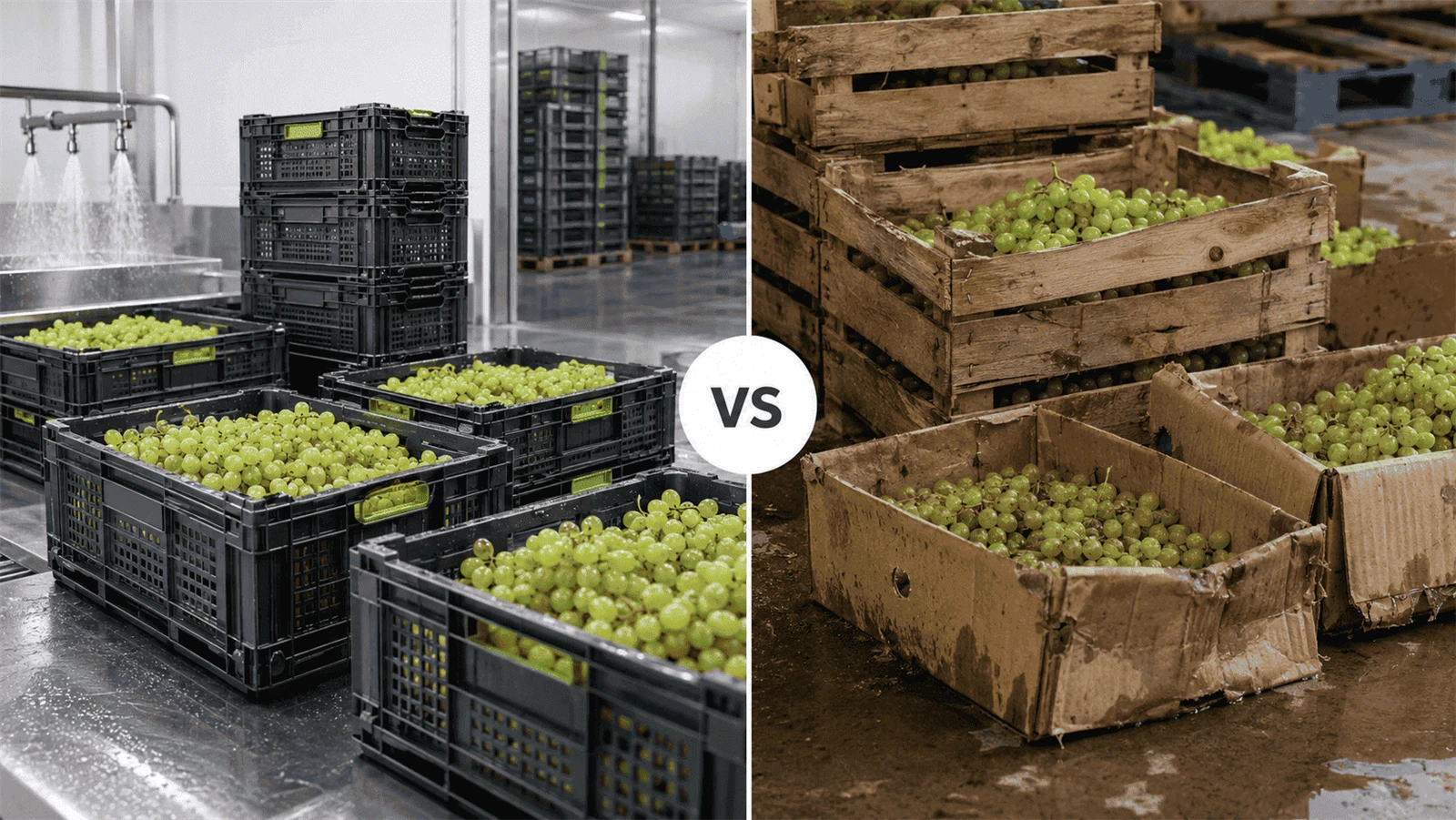
Plastic crates can be washed, reused many times, and hold up against moisture, which makes them a natural fit for circular supply chains. Reusable packaging like this pays for itself over multiple harvest cycles rather than getting replaced each season.
Cardboard works fine for single-use packaging or final retail display, but it loses strength fast once wet. Wooden crates are sturdy, but they bring extra cleaning work, splinter risk, and inconsistent sizing across batches.
If grapes cycle repeatedly between vineyard, packhouse, and cold storage, plastic crates hold up better across that loop. That's why more supply chains are shifting toward returnable containers, sometimes called RPCs.
What to Confirm Before Placing a Bulk Order
Don't just ask suppliers for a price quote. Share these details first: grape type and end use, expected load weight per crate, required internal dimensions and depth, and whether you need vented sides, a vented base, or both.
Also confirm the maximum stack height, whether crates go into cold storage, whether they need to match your pallet system, and whether you need folding or nesting crates. For export orders, lock in color, logo, order quantity, and destination early, since these details shape sample production and lead times.
If a supplier only gives you crate capacity without asking about load weight or how the crates will be used, that's not enough to know if the product fits. Before committing, request samples, confirm minimum order quantity and lead time, and ask about OEM customization for size, color, or branding.
Cleaning and Maintenance
Rinse the interior and base after each use to clear juice residue and stem debris before bacteria builds up. Set a cleaning schedule based on usage frequency and food safety protocol, rather than waiting until crates look dirty.
For long-term storage, keep crates out of direct sunlight. UV exposure makes plastic brittle over time, so stacking crates upside down in a shaded area extends their working life and cuts replacement costs.
Choosing the right crate comes down to managing risk at every stage between picking and delivery. Ventilation, depth, and stacking strength decide whether grapes arrive in good shape.
We're Enlightening Pallet, a manufacturer that's built collapsible plastic crates for vineyards, packhouses, and export traders for years, with custom sizing, colors, and bulk sampling available. Feel free to reach out if you're working through a sizing or sourcing question.
Frequently Asked Questions
Q: Are vented plastic crates good for grapes?
A: Yes. Ventilation lets air move through the crate, which helps during pre-cooling and cold storage.
Q: Should grape crates be deep?
A: Not necessarily. Deeper crates mean more stacked layers, so balance capacity, load weight, and how much pressure the fruit can handle.
Q: Are collapsible crates good for grape transport?
A: Yes, especially on routes where empty crates need to come back. Confirm stacking strength and airflow once the crate is unfolded.
Q: Can grape crates go into cold storage?
A: Yes, but check the material's rated temperature range first. Make sure your stacking pattern doesn't block the vent holes.
Q: Is PP or HDPE better for grape crates?
A: Both work for agricultural crates. Judge the crate by structure, weight, impact resistance, and operating temperature, not just the resin name.
Q: How often should grape crates be cleaned?
A: Base your schedule on usage and food safety requirements. Check for dirt, juice residue, or spoiled fruit before every reuse.
Q: How do you reduce bruising during grape transport?
A: Avoid overpacking, and pick a crate with smooth walls, the right depth, and a stacking design that keeps weight off the fruit.
Q: How do I pick the right crate size for a bulk order?
A: Start with grape type, load weight per crate, pallet dimensions, transport method, and handling equipment. Then confirm external size, internal height, and capacity.
