


What Should Buyers Look For When Choosing A Plastic Pallet Manufacturer?
A cheap quote can hide batch inconsistency, collapsing rack loads and pallets jamming your automated line. Choosing the wrong plastic pallet manufacturer costs far more than the price gap.
Look for a manufacturer that can prove five things: real in-house production, third-party load test reports for your exact model, controlled raw materials, verifiable certificates, and consistent dimensions. Then confirm capacity, test samples, and compare total cost, not unit price.
Below, I walk through nine checks in the order I would run them, from factory verification to total cost. Enlightening Pallet is a plastic pallet manufacturer, and every check here applies to Enlightening Pallet as much as to any other supplier on your shortlist.
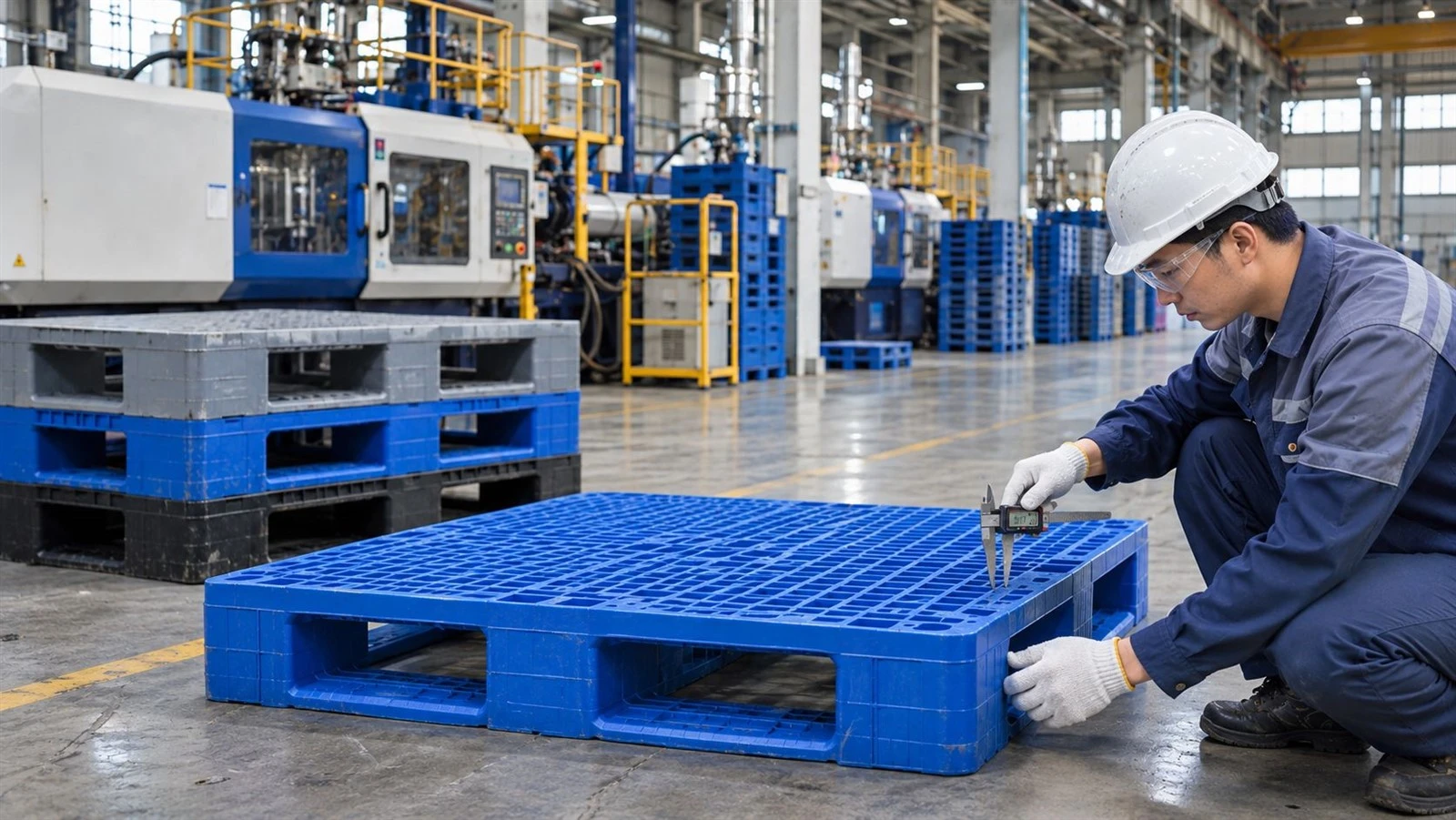
What Are the 9 Things to Check Before You Shortlist a Plastic Pallet Manufacturer?
Most buyers shortlist on price and website photos. Then the first container arrives with warped decks and mismatched sizes, and the whole project stalls.
Check nine things: real factory identity, model-specific load tests, raw material control, meaningful certifications, dimensional tolerance, capacity and lead time, sample performance, total cost, and after-sales support. A supplier that cannot document these should not make your shortlist.
The 9-Check Overview
|
# |
Check |
What to Ask For |
|
1 |
Real factory identity |
Machine list, mold ownership, live video tour |
|
2 |
Load evidence |
Static, dynamic and racking reports for your model |
|
3 |
Material control |
Resin type, virgin/recycled ratio, batch records |
|
4 |
Certifications |
Verifiable certificate numbers and scope |
|
5 |
Dimensional tolerance |
Latest batch QC report |
|
6 |
Capacity and lead time |
Monthly output, MOQ, peak-season availability |
|
7 |
Sample performance |
Samples tested on your own equipment |
|
8 |
Total cost |
Quote including freight, duties and mold fees |
|
9 |
After-sales support |
Warranty terms, complaint process, reorder support |
Why the Order Matters
I run the checks in this sequence because each one filters out suppliers cheaply. Factory identity and test evidence cost nothing to request, so start there. Samples and trial orders cost real money and time, so save them for the two or three suppliers that survive. The sections below explain each check in detail.
Is It a Real Manufacturer or a Trader?
Plenty of suppliers look like factories online. Then a quality issue appears, and nobody who controls the mold or the machine will pick up the phone.
A real manufacturer owns or controls its molding machines and molds, can name machine tonnage and monthly output, and lets you verify production by live video or site audit. A trader usually cannot show these details or explain who is responsible for quality.
Factory Evidence to Request
|
Evidence |
What Good Looks Like |
|
Molding machine list |
Machine models and clamping tonnage suited to pallet-size molds |
|
Mold ownership |
Written confirmation of who owns each mold |
|
Monthly output |
Figures tied to named production lines, not a round number |
|
Business and factory address |
Matches the production site shown on video |
What to Look for on a Live Video Tour
Machines running pallets similar to yours, with nameplates you can read.
Labeled mold storage and a separate raw material warehouse.
A QC station with real measuring tools, not just a table.
Finished pallets packed and staged for shipment.
I would not skip this step for any large order. A supplier unwilling to show the floor is already answering your question. Enlightening Pallet is a plastic pallet manufacturer, and buyers are welcome to hold Enlightening Pallet to this same standard.
Are Static, Dynamic and Racking Load Ratings the Same Number?
A catalog says "rated 1,500 kg" and you assume it is safe on your racks. Then a deck sags between the beams.
No. Static load applies on a flat floor, dynamic load applies while moving with forklifts or pallet jacks, and racking load applies on beams with unsupported spans. A high static rating does not guarantee a high racking rating.
The Three Load Ratings
|
Load Type |
Real-World Condition |
What Can Go Wrong |
|
Static |
Stacked on a flat floor |
Long-term deformation under constant load |
|
Dynamic |
Lifted and moved by forklift or pallet jack |
Deck bending, fork entry damage |
|
Racking |
Spanning two beams with a gap in between |
Sagging, deflection, drop-through |
How Temperature and Load Distribution Change Results
A rating measured at room temperature may not hold in a freezer or a hot process area. Load shape matters too. Evenly spread cartons stress a pallet very differently from drums or machinery sitting on a few contact points.
Ask for Third-Party Reports
Request reports for your exact model, with the test method, temperature, support condition and load pattern stated. ISO has published a 2025 edition of ISO 8611-1 covering pallet test methods, and ASTM D1185 is also widely referenced. Lab results still do not replace a trial in your own warehouse. Only compare suppliers' figures when the support conditions match.
HDPE or PP, Virgin or Recycled: Which Material Is Right for You?
Two pallets can look identical and behave very differently. Without material control, the second batch may not match the sample you approved.
HDPE offers better impact resistance and low-temperature toughness, while PP is typically stiffer and more heat-resistant. Virgin or recycled is not automatically good or bad. What matters is fit for your environment and the manufacturer's ability to control batch consistency.
HDPE vs PP at a Glance
|
Property |
HDPE |
PP |
|
Impact resistance |
Higher |
Moderate |
|
Low-temperature performance |
Better |
Weaker in deep cold |
|
Rigidity |
Moderate |
Higher |
|
Heat resistance |
Moderate |
Higher |
These are general tendencies. Actual results depend on grade, additives and pallet design.
Virgin vs Recycled Material
Virgin material does not guarantee a good pallet, and recycled material does not guarantee a weak one. I ask four questions:
Is the pallet made from virgin material, recycled material, or a blend?
What grade and specification does the resin follow?
Are incoming materials inspected batch by batch?
Does performance stay stable in cold, heat or outdoor use?
Request the material data sheet (MDS) and melt flow index (MFI), and ask for written notice before any resin or recycled-content change.
Which Certifications Actually Mean Something?
A wall of certificates looks reassuring. But if none covers pallet manufacturing or your model's load test, the paperwork protects nobody.
Look for ISO 9001 with a scope that covers pallet production, third-party inspection or audit reports, and food-contact compliance if relevant. Verify certificate numbers, validity and issuing body. ISO 9001 describes a quality system; it does not prove a specific pallet passed load tests.
What Each Document Really Tells You
|
Certificate or Standard |
What It Tells You |
What to Verify |
|
ISO 9001 |
Quality management system |
Scope includes pallet production, still valid, issuer named |
|
ISO 14001 |
Environmental management system |
Scope and validity |
|
ISO 8611 |
Test method, not a certificate |
Report names the method, model and conditions |
|
FDA or EU food-contact rules |
Material suitability for food use |
Applies to the exact material, product and target market |
|
Third-party audit or inspection |
Independent view of the factory |
Report date and who commissioned it |
|
REACH / RoHS |
Chemical compliance for some EU uses |
Only if your market or industry requires it |
How to Verify a Certificate
Ask for the certificate number, check it on the issuing body's website, and confirm the expiry date and scope. A food-contact statement for one resin does not automatically cover every product made from another.
How Tight Should Dimensional Tolerances Be?
Pallets that are a few millimeters off rarely bother a manual warehouse. On a conveyor or automated line, they cause jams and stoppages.
Many standard applications accept about ±2 mm on main dimensions, while automated storage systems often demand tighter control, sometimes around ±0.5 mm. Always follow your equipment's specification, and ask for the latest batch QC report rather than a verbal promise.
Tolerance Guidance by Use
|
Use |
Tolerance Approach |
|
Manual handling, floor storage |
Moderate; about ±2 mm is often acceptable |
|
Beam racking |
Tighter control on dimensions that affect beam support |
|
Conveyors and AS/RS |
Tightest; some systems need about ±0.5 mm. Follow the system supplier's specification |
What the QC Report Should Show
A useful report lists the sample size, measured length, width and height, weight, and flatness or deflection checks, all from a recent production batch. A report from the last run beats any promise. If the supplier cannot produce one, the production run probably will not hold tolerance either.
Can the Factory Handle Your Capacity, MOQ and Lead Time?
Great samples mean little if the factory is booked solid. A late shipment can stall your own production plan for weeks.
Ask for monthly production capacity, free capacity during your peak season, MOQ per size, and separate lead times for standard and custom orders. Confirm capacity in writing before paying any deposit, and check that export packaging and documents are covered.
Questions to Ask Before You Pay a Deposit
|
Question |
Why It Matters |
|
What is your monthly capacity for my model? |
Shows whether your volume is realistic |
|
How much capacity is free in my peak months? |
Avoids surprise delays |
|
What is the MOQ per size and per color? |
Prevents hidden volume requirements |
|
What are the lead times for standard vs custom? |
Lets you plan your own schedule |
Custom Orders: Clarify Mold Costs Early
If you need a custom size, logo, color, anti-slip surface or reinforced structure, ask about mold development cost, development time, mold ownership and the fee for later modifications. Low quotes sometimes leave these out, and the final bill grows.
Export Readiness
For overseas orders, confirm export packing, container loading plans and documents such as the packing list and commercial invoice. Check that the supplier knows your destination's pallet sizes and import requirements.
How Should You Test Samples Before Committing?
Skipping the sample stage feels faster. Then the bulk order arrives, the pallets won't fit your racks, and fixing it costs far more.
Test samples in seven steps: weigh them, measure dimensions, inspect finish, run them with forklifts, load them on your racks, stack them, and expose them to your real temperatures. Use your actual products and equipment, not generic test loads.
The 7-Step Sample Check
|
Step |
What to Do |
What a Good Result Looks Like |
|
1. Weight |
Weigh several samples |
Matches the specification, with little variation |
|
2. Dimensions |
Measure key dimensions |
Within agreed tolerance |
|
3. Appearance |
Inspect molding quality and color |
No flash, voids or warping |
|
4. Forklift |
Handle with forklifts and pallet jacks |
Smooth fork entry, no cracking |
|
5. Racking |
Load on your own beams |
Deflection within your limit |
|
6. Stacking |
Stack loaded pallets |
Stable, no creep or lean |
|
7. Temperature |
Test in your real cold or heat |
No brittleness or softening |
Trial with Your Real Products and Equipment
Load the sample with your actual product and run it through your conveyors, racks and automated equipment. Watch deck deflection, load stability and fork entry. If sanitation matters, test cleaning and drying too. Enlightening Pallet encourages buyers to test before they buy, and I suggest running this same routine on any sample, including a sample from Enlightening Pallet. Once samples pass, place a small trial order to check consistency, delivery and communication before scaling up.
Why Does Total Cost Matter More Than Unit Price?
The cheapest quote often looks like a win. Twelve months later, replacements, damaged goods and extra freight quietly erase the savings.
Total cost of ownership adds purchase price, freight, duties, handling, damage and replacement costs, then subtracts any recovery value, spread over service life. A slightly pricier pallet that lasts twice as long usually costs less per year of use.
The TCO Formula
Annual cost per pallet = (unit price + freight + duties + handling + expected damage and replacement cost − recovery value) ÷ service life in years
An Illustrative Example
The numbers below are hypothetical. Replace them with your own quotes and trial results.
|
Item |
Pallet A (Lower Quote) |
Pallet B (Higher Quote) |
|
Unit price |
$20 |
$26 |
|
Freight and duties per pallet |
$3 |
$3 |
|
Total landed cost |
$23 |
$29 |
|
Service life |
3 years |
6 years |
|
Cost per year of use |
$7.67 |
$4.83 |
Service life should not rest on a verbal promise. Back it with test data, customer feedback and your own trial. Also add mold, design and modification fees to the comparison if you order custom pallets.
What Red Flags Should Make You Walk Away?
Some warning signs show up before you sign anything. Ignore them, and you inherit the problem along with the pallets.
Walk away if a supplier gives only one load number, offers only self-issued test reports, refuses third-party testing, won't name the resin type, can't provide batch traceability, or pushes you to skip samples and pay a large deposit immediately.
Red Flags in the Quote
|
Red Flag |
Why It Matters |
What to Ask Instead |
|
One load number only |
Hides differences between static, dynamic and racking |
"Show all three ratings and the support conditions." |
|
Resin type not stated |
You cannot judge performance or consistency |
"Which resin, and virgin or recycled?" |
|
Mold and design fees missing |
Final cost grows later |
"Please itemize all tooling costs." |
Red Flags in the Conversation
|
Red Flag |
Why It Matters |
What to Ask Instead |
|
Self-issued test reports only |
No independent proof |
"Can you share a third-party report?" |
|
Refusal to allow video tour or audit |
Production cannot be verified |
"When can we schedule a live tour?" |
|
No batch traceability |
Problems are hard to trace |
"How do you track batches?" |
|
Pressure to skip samples |
Risk shifts to you |
"I will test samples first." |
How Should You Choose Based on Your Use Case?
A feature-packed pallet is not always the right pallet. Paying for the wrong features wastes budget while the real requirement goes unmet.
Match the pallet to the job: food and pharma need compliant, easy-to-clean designs; automated warehouses need precise dimensions and racking strength; export shippers need light, cost-efficient pallets; closed-loop users need durability. Define your use case before comparing quotes.
What to Prioritize by Industry
|
Use Case |
Top Priorities |
|
Food and beverage |
Food-contact compliance, hygienic design, easy cleaning, chemical resistance |
|
Pharmaceutical |
Material compliance, cleaning control, traceability |
|
Logistics and automated warehousing |
Dimensional accuracy, dynamic and racking load, structural stability |
|
Automotive |
Load capacity, durability, custom size, line compatibility |
|
Export and international shipping |
Weight, pallet size, freight cost, export documents, delivery reliability |
|
Closed-loop circulation |
Long service life, repairability, return handling |
If your use case is not listed, send your requirements to Enlightening Pallet so the specification can be reviewed against your real conditions before you request a quote.
Where Can You Get a Supplier Scorecard and RFQ Checklist?
Comparing quotes from memory leads to gut-feel decisions. A written scorecard turns a messy comparison into a fair one.
Download the free supplier scorecard below. It scores each manufacturer from 1 to 5 across load evidence, materials, certifications, tolerance, capacity, samples, total cost and service, and links each score to the RFQ specifications you should send.
Suggested Scorecard Weights
|
Criterion |
Suggested Weight |
|
Load test evidence |
20% |
|
Material control |
15% |
|
Real factory verification |
10% |
|
Certifications |
10% |
|
Dimensional tolerance |
10% |
|
Capacity and lead time |
10% |
|
Sample performance |
10% |
|
Total cost |
10% |
|
After-sales support |
5% |
Adjust the weights to your risk. An automated warehouse should weight tolerance higher, and a food business should weight compliance higher.
What Your RFQ Should Include
State your use case, load profile, support conditions, dimensions and tolerances, material requirements, required certificates, order quantity and delivery target. The clearer your RFQ, the fewer guesses in the quote. You can send your RFQ to Enlightening Pallet and compare the response against your scorecard.
What Else Do Buyers Ask Before Choosing a Plastic Pallet Manufacturer?
How much does a plastic pallet cost compared with wood?
Plastic usually costs more upfront than wood. In closed-loop systems, longer service life, consistent size and lower repair needs can make plastic cheaper per trip. One-way export may favor lower-cost options, so compare total cost, not price alone.
What certifications should a plastic pallet manufacturer have?
Start with ISO 9001 whose scope covers pallet production. Add third-party test or inspection reports, food-contact compliance for your market if relevant, and REACH or RoHS where required. Always verify certificate numbers.
Are plastic pallets exempt from ISPM-15?
ISPM 15 applies to wood packaging material. Plastic pallets are not wood, so the treatment and marking requirement does not apply, which can simplify paperwork. Still check your destination country's import rules.
How do I verify a plastic pallet load rating?
Request a third-party report for your exact model under a recognized method such as ISO 8611-1 or ASTM D1185. Check the support condition, temperature and load pattern, then confirm with a sample trial.
What is a typical MOQ for plastic pallets?
MOQ varies by size, color, process and whether tooling is custom. Standard sizes usually have a lower MOQ than custom-molded designs. Ask for MOQ per size and per color, and confirm any mold fees in writing.
Conclusion
Choose a plastic pallet manufacturer that proves its claims with tests, samples and traceable materials. Enlightening Pallet invites you to put every check in this guide to the test.
