


What Are Collapsible Crates Used For — And Are They Worth It?
Every return truck carrying empty rigid containers is paying freight on wasted space. That single inefficiency is one of the main reasons collapsible crates have become a standard tool across global supply chains.
A collapsible crate is a reusable plastic container with hinged side walls that fold flat when empty and lock upright when loaded. Collapsible crate uses span fresh produce logistics, food distribution, retail, cold chain operations, and industrial warehousing - wherever reducing container volume on the return journey directly reduces operating cost.
This guide covers how collapsible crates work, where they perform best, what separates a quality product from a poor one, and what to ask before choosing a supplier.
What Is a Collapsible Crate, and How Does It Work?
Understanding the structure helps you evaluate what you are actually buying.
The four side walls of a foldable plastic crate connect to the base through a continuous hinge. When empty, all walls fold inward and flat, reducing the unit to a fraction of its loaded height. When in use, the walls lock upright through a tab-and-slot mechanism, keeping the structure rigid under load. Most plastic folding crate stackable designs are stable in both states - folded units stack flat in storage, and loaded crates stack securely in transit without shifting.
The body is manufactured from HDPE (high-density polyethylene) or PP (polypropylene). Both materials resist moisture, cleaning agents, and repeated mechanical impact, which is why a quality folding crate outlasts cardboard alternatives across hundreds of use cycles.
Standard footprints follow common logistics dimensions. In European supply chains, 600×400mm is a widely adopted base size, and load capacity typically ranges from 20 to 50 kilograms depending on wall thickness and design grade. Choosing the right spec for your actual workflow matters more than choosing the cheapest option.
Does Hinge Quality Really Matter?
The hinge is the most stressed component in any collapsible plastic crate, and it is where quality differences appear first.
Under high-frequency use, a poorly engineered hinge will loosen or crack within months. A well-designed hinge paired with a reliable locking tab sustains thousands of open-close cycles under normal operating conditions. Before committing to a bulk order, ask your supplier for hinge cycle life test data - that number tells you more about long-term durability than unit pricing or visual inspection alone.
Which Industries Use Collapsible Crates the Most?
Collapsible crate applications extend across more sectors than most buyers initially expect, and the reasons differ meaningfully by industry.
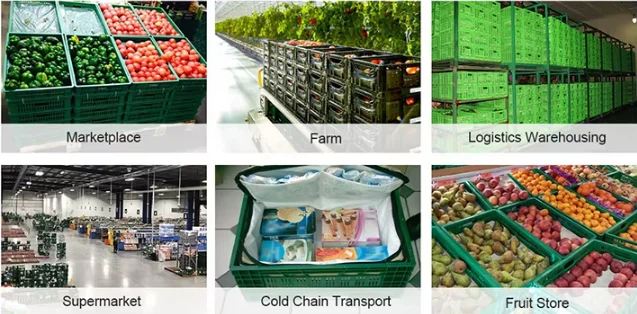
Each sector uses the same product form but for different reasons - ventilation in produce, temperature resistance in cold chain, and handling efficiency in retail. Understanding which factors matter in your sector helps you specify the right product from the start.
Agriculture and Fresh Produce
In fresh produce supply chains, the crate does more than hold product - it actively protects it during every step of transit.
A vented collapsible plastic crate allows air to circulate around fruit and vegetables during transport, slowing the heat buildup that accelerates spoilage. This is the central reason collapsible crate agriculture use is so widespread: ventilation design directly reduces post-harvest loss, which in some supply chains accounts for a meaningful share of total product volume.
From field harvest through to a supermarket collapsible crate program on the retail floor, the same unit handles every handoff without repacking at each stage. For buyers entering regulated retail channels, food-contact material compliance is a baseline requirement - the crate material must not transfer harmful substances to the product, and documentation should be confirmed before contracts are signed.
Retail, Cold Chain, and Industrial Use
Beyond fresh produce, collapsible crates serve three other distinct operational contexts, each with different functional priorities.
In retail distribution, a collapsible crate for vegetables or packaged goods can move from warehouse to store shelf as a single handling unit, eliminating the repacking steps that add labor time and increase the risk of product damage.
In cold chain logistics, PP retains its structural properties at sub-zero temperatures, whereas some alternative materials become brittle and unreliable below -10°C - an important distinction for any buyer managing refrigerated or frozen product flows.
In industrial operations, color-coded crate systems support visual sorting in warehouse environments, reducing handling errors without requiring additional software investment. One product form, three operational demands.
Do Collapsible Crates Actually Save Money?
The upfront cost of a collapsible warehouse crate is higher than cardboard, but that single comparison misses where the real cost sits.
A collapsible crate storage system cycling through a distribution network for three to five years spreads its unit cost across hundreds of individual uses.
Cardboard is replaced after one trip. When the full lifecycle is considered, the per-use cost of a reusable collapsible crate consistently falls below the cumulative spend on repeat cardboard orders - and that gap widens as order frequency increases.
The Return-Trip Argument
Folded crates are where logistics savings become most visible and most direct.
A rigid container completing a delivery returns at full volume - you are paying freight on empty space. A folded crate occupies a fraction of that volume, so a single return truck carries significantly more units per run.
For high-frequency distribution networks such as supermarket replenishment routes or agricultural logistics hubs, this compounds into real freight savings over time. Beyond cost, the collapsible crate advantages argument has also moved into compliance territory: major retailers are increasingly embedding reusable packaging requirements into their supplier qualification criteria, making this a procurement policy issue as much as a finance one.
What Makes a Good Collapsible Crate?
A 20 to 30 percent price difference between suppliers often reflects a genuine difference in how long the product holds up under daily operating conditions.
Three factors determine quality in any collapsible crate food grade or industrial application. Structural integrity comes first: the hinge and locking tab must keep a stacking collapsible crate rigid when loaded and stacked under weight, not just when empty on a shelf.
Temperature resistance is the second factor: materials that perform well at room temperature may crack or deform in continuous cold storage, which matters most for applications like a collapsible crate for meat or other refrigerated goods where cold chain exposure is ongoing.
Material certification is the third: food-contact compliance to FDA or EU EC 10/2011 standards is a hard requirement in regulated markets, and the relevant test certificate should be requested at the inquiry stage - not at pre-shipment inspection, when it is too late to act on.
How Long Should a Crate Last?
A well-made crate sustains hundreds to thousands of open-close cycles under normal conditions, but the range depends on hinge quality and whether daily loads consistently stay within rated capacity.
Overloading is the fastest way to shorten hinge life, regardless of initial build quality. When comparing suppliers, documented cycle life test results are more reliable than warranty language, because test data reflects controlled performance rather than contractual promises. Buyers who skip this comparison typically encounter the quality difference by their second or third order, not their first.
How Do You Choose the Right Collapsible Crate Supplier?
Finding a reliable collapsible crate manufacturer is harder than finding the lowest quote - and it is the decision that affects every order that follows.
Five questions are worth asking before placing any bulk commitment.
First, can the supplier provide material certification documentation for your target market - not just verbal assurance, but an actual test report?
Second, what hinge cycle life test data can they share, and under what test conditions was it collected?
Third, do they support collapsible crate custom configurations - dimensions, wall thickness, color-coding - or are you limited to a fixed catalog?
Fourth, what are their MOQ (minimum order quantity) and standard lead times, and how do they handle volume increases at short notice?
Fifth, what is their process when damaged units need replacement in the field?
Sourcing collapsible crate wholesale from a qualified collapsible crate supplier is not a single transaction.
A supplier who knows your specifications, communicates reliably on lead times, and resolves quality issues without friction is worth more than a marginal price saving - especially when your own customers are depending on your delivery.
Conclusion
Collapsible crates reduce freight and storage costs, adapt across multiple industries, and meet compliance standards that single-use packaging cannot match. Matching the right product to your workflow - and the right supplier to your standards - is where the value becomes real.
