


How To Choose The Right Size Plastic Pallet Box For Agricultural Products?
Picking a bin that is "big enough" is not the same as picking the right one. A plastic pallet box that is too large strains your forklift and crushes bottom-layer produce. One that is too small multiplies your handling time and drives up labour costs across a full harvest season.
The right size plastic pallet box for agricultural use comes down to four things: your daily harvest volume, your crop's weight per unit of volume, your forklift's load limit, and your cold store height. Work through these four points in order, and the decision becomes much clearer.
Wooden crates and metal bins were once the default in agriculture, but they absorb moisture, splinter, and are hard to sanitise between loads. A full mesh HDPE plastic pallet box solves all three problems while giving you a reusable, forklift-compatible container that works from field to cold store to truck. The sections below walk through how to size one correctly.
What Does "Size" Actually Cover in a Plastic Pallet Box?
Size is not one number. It covers four separate dimensions, and each one affects a different part of your operation.
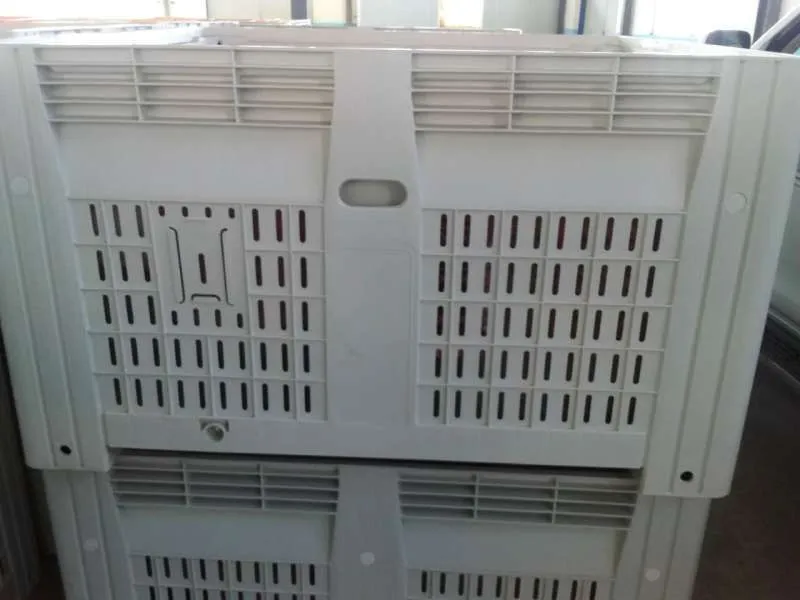
The first is external footprint - the length and width of the base. A 1200×1000mm footprint matches Euro-standard pallet dimensions, so the box loads cleanly into standard shipping containers and sits flush on most warehouse racking. The second is internal volume, measured in litres. A 606L large plastic pallet box sounds straightforward, but volume only tells you how much space is available, not how much weight that space holds when filled with your crop.
That weight depends on your crop's bulk density, which brings in the third dimension: load capacity. Static load - the weight the box holds when stacked and stationary - and dynamic load - the weight it handles during forklift movement - are hard limits, not rough estimates. A heavy duty plastic pallet box with a 4T static load and 1T dynamic load can handle most field crops safely, but you still need to verify the filled weight before committing to a size. The fourth dimension is height, which determines how many units you can stack in your cold store and how well air moves through a loaded pallet.
Getting all four right matters because they interact. A box with the right volume but the wrong height may prevent stacking in your storage space. A box with the right footprint but an underestimated load capacity is a forklift accident waiting to happen.
How Do You Match Box Size to Your Crop?
The starting point is understanding how your crop behaves inside a box - specifically, how much it weighs per unit of volume.
This is called bulk density. Root vegetables like potatoes and carrots are dense, typically 600–700 kg per cubic metre. Stone fruits like peaches and plums sit around 500–550 kg/m³. Soft produce like berries and leafy greens is much lighter, often below 300 kg/m³. A plastic pallet box that works fine for onions may overload your forklift if you fill the same volume with beetroot - because beetroot is denser. Always check the weight, not just the volume.
The second factor is crop fragility. Delicate produce - tomatoes, grapes, stone fruit - needs a shallower fill depth to avoid pressure damage at the bottom. For these crops, a lower-profile box or a partial-loading practice reduces the risk. Dense, firm crops like potatoes and squash can use deeper boxes at full capacity without the same concern.
If you handle multiple crop types across a season, a single fixed size may not work well for all of them. A range of standard sizes - or a custom-height option from a plastic pallet box manufacturer - lets you match the box to the crop rather than the other way around. This is especially relevant for operations that supply different buyers with different handling requirements throughout the year.
How Many Boxes Do You Actually Need?
Knowing the right size is half the answer. The number of boxes in rotation matters just as much - too few and your harvest line stalls; too many and you are paying for idle stock sitting in a yard.
A straightforward way to estimate your requirement:
| Step | What to calculate | Example (apples, ~450 kg/m³) |
|---|---|---|
| 1 | Daily harvest volume | 4,000 kg/day |
| 2 | Usable capacity per box | 606L × 0.45 kg/L × 85% fill rate ≈ 232 kg |
| 3 | Boxes needed per day | 4,000 ÷ 232 ≈ 18 boxes |
| 4 | Total boxes in rotation | 18 × 3-day turnover cycle = 54 boxes |
The 85% fill rate accounts for headspace and uneven loading. Filling a box to the brim makes the load unstable during stacking and presses against the top layer of produce. The turnover cycle is how long a box stays loaded before it is emptied, cleaned, and returned to the field.
Add a 15–20% buffer on top of your calculated total to cover peak harvest days and boxes held in cleaning or transit. For operations with large plastic pallet box storage needs - multiple crop lines running at the same time - it is worth running this calculation separately for each crop and adding the totals together rather than estimating in one go.
Does Your Equipment Set the Real Limit?
Once you have a size in mind, check it against your existing equipment before placing an order. This step is where most sizing mistakes are caught - or missed.
The most common error is selecting a box based on volume alone, then discovering it overloads the forklift when full. A 606L box filled with dense root vegetables can approach or exceed 1,000 kg. If your forklift's rated dynamic load is 1 tonne, that leaves no margin for inclines, uneven ground, or sudden stops. As a working rule, keep your loaded box weight below 80% of your forklift's rated capacity.
The second check is cold store or warehouse ceiling height. A stackable plastic pallet box with a 4T static load rating can handle multiple layers structurally, but your ceiling clearance sets the practical limit. Measure from floor to the lowest overhead obstruction, divide by the stacked height of one box, and round down. That is your maximum stack. Finally, check your truck or container dimensions.
A 1200×1000mm footprint loads efficiently into 20ft and 40ft containers and fits two rows across a standard refrigerated truck - so you are not losing space to awkward gaps on every outbound load. For anyone sourcing plastic pallet boxes for export, this footprint compatibility with international container standards makes a real difference to freight cost per unit.
What Happens When You Get the Size Wrong?
The costs of a wrong-size box are predictable, but they tend to stay invisible until they add up across a whole season.
A box that is too large creates two problems. Partial loads are unstable during forklift handling, and a fully loaded box may exceed your equipment's safe operating range. A box that is too small means more handling - more boxes to move per tonne of crop, more forklift cycles, and more chances for produce to be damaged during transfer. If you supply a packing house or distributor on a fixed schedule, extra handling rounds at the wrong moment can delay an entire outbound shipment.
Height errors are subtler but just as costly. A box that is too tall reduces the number of stack layers your cold store can hold, quietly cutting your effective storage capacity. A box that is too shallow means you need more units to hold the same volume - and more units means more floor space, more handling, and a higher cost per tonne stored.
A reusable plastic pallet box is built to last many seasons, which means the sizing decision you make now follows you for years. Getting it right once is far cheaper than correcting it after a full season of inefficiency.
Why Do Ventilation and Hygiene Matter?
For fresh produce, airflow and cleanliness directly affect how much of your harvest reaches the buyer in sellable condition - and whether your operation clears food safety audits.
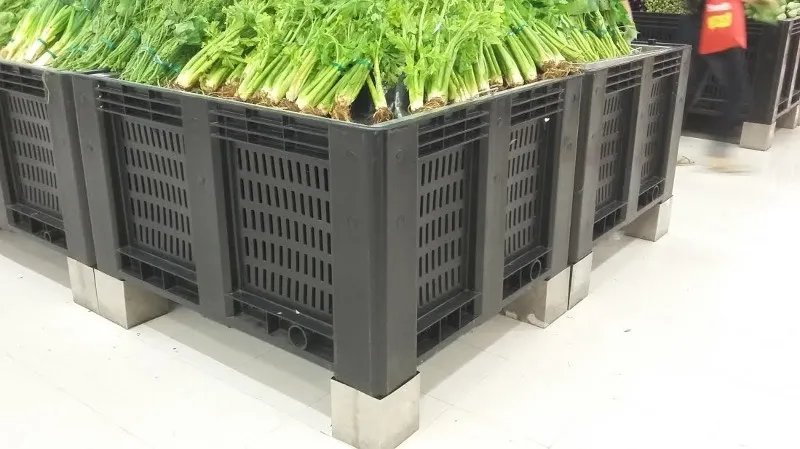
A full mesh plastic pallet box allows air to move through all four walls and the base. This matters most in the hours after harvest, when crops are still releasing field heat. If that heat cannot escape, temperature builds up inside the box and accelerates spoilage - even inside a refrigerated cold store with active cooling.
The mesh wall design also supports forced-air cooling, a method used in larger packing houses where cold air is pushed through rows of stacked boxes to drop core temperature quickly.
Does It Meet Food Safety Requirements?
HDPE plastic is non-porous. It does not absorb moisture, bacteria, or odours between uses - a problem that wooden crates are never fully free of. A mesh box can be washed down and returned to service quickly. For operations working toward GAP certification or FSMA compliance, or supplying buyers who require documented hygiene standards, this makes a practical difference at audit time.
If your downstream customers have specific requirements around food contact materials, confirm HDPE food-grade compliance with your supplier before ordering. A food grade plastic pallet box manufacturer should be able to provide material certification without hesitation.
For operations that supply across multiple markets with different standards, that documentation simplifies the process considerably - and gives your buyers something concrete to pass along their own supply chain.
The Right Box Saves More Than Space
Most buyers think about bin size as a storage problem. But the right plastic pallet box also determines your labour cost per tonne, your freight efficiency, and your post-harvest loss rate - all at once.
If you are sourcing in bulk or need sizes that match a specific crop line, working directly with a plastic pallet boxes wholesale supplier or custom plastic pallet box factory gives you more flexibility than buying off the shelf. Standard sizes cover most scenarios, but custom dimensions are available when your harvest volume, crop type, or facility layout calls for something more specific.
Send us your daily harvest volume, crop type, and storage setup - we will recommend the right configuration from our range, or quote a custom size that fits your operation exactly.
