


How To Choose The Right Plastic Bulk Container Type For Maximum ROI?
Supply chain managers face a tough choice when selecting plastic bulk containers. The wrong type can drain your budget through hidden costs like wasted transport space, premature replacements, and system incompatibility. This guide helps you make data-driven decisions.
Plastic bulk containers fall into three main categories: collapsible types save up to 75% on return shipping costs, rigid types offer superior stacking strength (6-8 layers safely), and industry-specific customized versions meet specialized needs like food-grade certification or chemical resistance. Your optimal choice depends on transport distance, turnover frequency, and cargo characteristics-not just initial price.
Before diving into specific types, consider this: industry data shows over 60% of companies focus solely on purchase price when buying bulk containers plastic, ignoring lifecycle costs like maintenance, space utilization, and replacement rates. This mistake often forces them to overhaul their entire container system within 18-24 months. The following framework helps you avoid this expensive trap.
What Are the Main Types of Plastic Bulk Containers?
Understanding container types through a decision lens-structure, material, and application-matters more than memorizing product codes.
The market floods you with hundreds of bulk container specifications, but from a supply chain efficiency angle, they boil down to three decision dimensions: structural flexibility (collapsible vs rigid), material performance (HDPE vs PP), and application specialization (universal vs customized). Grasping this classification logic beats remembering every model number.
Plastic bulk containers split into two structural categories: collapsible and rigid. Collapsible bulk containers compress to 25-30% of original height when empty, ideal for one-way logistics or long-distance return trips, cutting return transport costs by 75%. Rigid plastic containers deliver higher load capacity (typically 1000-1500kg) and stacking stability, fitting warehouse-intensive and high-frequency turnover scenarios. Your core decision point is "empty return frequency."
What Standard Sizes Work Best with Pallets?
Choosing the right container size means matching your existing pallet systems and maximizing container space.
Plastic bulk storage containers follow international pallet standards to ensure logistics infrastructure compatibility. European operations typically use 1200×800mm footprints matching EUR pallets, while North American facilities prefer 1200×1000mm dimensions aligned with standard 48×40-inch pallets. Container capacity ranges from 200 liters for small automotive parts to 1200 liters for bulk materials, and your selection should balance cargo density with pallet compatibility.
The bottom structure matters too. Four-way entry designs allow forklift access from all sides, speeding up loading operations by 30-40% compared to two-way entry models. For container shipping, standard-sized bulk plastic containers optimize 40-foot container utilization, often achieving 95%+ loading efficiency when properly configured.
How Does Foldability Impact Your Logistics Cost?
Collapsible containers transform return shipping economics, but they come with trade-offs you need to understand.
Collapsible bulk containers deliver core value through space efficiency. When a 40-foot container loads empty rigid containers, it holds only 80-100 standard units. Switch to collapsible designs, and the same container accommodates 300-350 folded units. In automotive parts industries with typical "supplier→factory→empty return" cycles, collapsible types reduce return trips to one-third of the original number.
However, collapsible containers aren't universal solutions. Their hinge connections typically cost 15-25% more upfront than rigid equivalents, and each fold/unfold operation consumes 30-45 seconds of labor time. If your turnover frequency exceeds 10 cycles daily, these labor costs accumulate rapidly. Collapsible types suit "low-frequency, long-distance, clear empty return" scenarios like international trade with one-time delivery and empty container recovery.
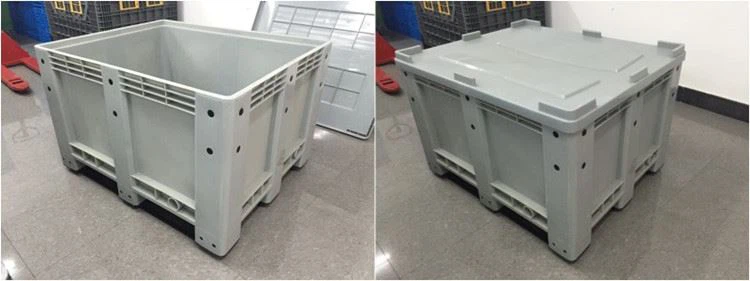
Rigid containers excel through structural stability. Their one-piece molded design withstands higher stacking pressure, safely supporting 6-8 layers (total weight 8-10 tons), while collapsible versions max out at 4-5 layers due to hinge stress points. In regions with expensive warehouse space like Japan or Singapore, rigid containers' vertical space utilization advantage becomes clear. Additionally, rigid types average 8-10 years of service life versus 5-7 years for collapsible models due to moving parts wear.
Which Material Delivers the Best Durability?
Material choice determines whether your containers survive specific environments-cold chains, chemical exposure, or outdoor storage.
Material selection directly decides if containers survive your specific environment. An HDPE container performing excellently in -20°C cold storage might degrade rapidly when exposed to organic solvents. Material isn't about higher cost equaling better performance-it's about better matching.
Plastic bulk containers primarily use HDPE (high-density polyethylene) and PP (polypropylene). HDPE offers superior impact resistance and low-temperature toughness, handling -40°C to +80°C ranges, common in cold chain logistics and outdoor storage. PP provides higher heat tolerance (up to +100°C) and better chemical corrosion resistance, making it the first choice for food, pharmaceutical, and chemical industries. Density differences also affect weight: PP containers weigh 8-12% less than HDPE equivalents at the same volume.
| Material | Temperature Range | Best Applications | Key Advantage |
|---|---|---|---|
| HDPE | -40°C to +80°C | Cold chain, outdoor storage, automotive | Superior impact resistance |
| PP | -20°C to +100°C | Food processing, pharmaceuticals, chemicals | Chemical resistance & heat tolerance |
HDPE's linear molecular structure gives it outstanding impact performance. In automotive parts industry testing, HDPE bulk containers dropped from 1.5-meter heights showed under 5% breakage rates, while PP containers at equivalent thickness broke 12-18% of the time. This makes HDPE ideal for frequent forklift handling and rough loading environments.
But HDPE has clear shortcomings. Its chemical resistance remains relatively weak, and long-term contact with acidic or oily substances causes surface softening. I once saw a lubricant distributor using HDPE containers to store mineral oil-after six months, container bottoms showed seepage. Switching to PP material, the same conditions showed good condition after three years. PP's chemical stability comes from its side-chain methyl structure, effectively resisting most organic solvents and acid-base solutions.
Temperature adaptation marks another key difference. HDPE's glass transition temperature sits around -110°C, meaning it maintains flexibility even in extreme cold. A Nordic cold chain company used HDPE containers in -35°C freezers, and testing after five years showed less than 10% material performance degradation. PP becomes brittle below -20°C, unsuiting extreme cold environments. But on the high end, PP withstands brief 100°C temperatures, fitting food processing scenarios requiring high-temperature cleaning and sterilization.
How Do Industry Needs Shape Container Design?
Generic containers handle 80% of basic needs, but the remaining 20% of industry-specific requirements often determines supply chain success or failure.
Universal containers might meet 80% of basic requirements, but the remaining 20% of industry-specific needs often determines supply chain success or failure. Automotive parts bulk containers need anti-static coatings protecting precision electronics, food-safe plastic storage containers require FDA-certified non-toxic materials, and chemical industries need UN hazardous goods transport certification.
Different industries demand distinct priorities from plastic bulk containers. Automotive parts operations prioritize "protection"-requiring built-in EVA cushioning pads, anti-static coatings, and precision divider designs to safeguard delicate components during JIT delivery. Food and beverage sectors emphasize "hygiene"-mandating FDA 21 CFR 177.1520 certified food-contact materials with smooth, crevice-free surfaces for easy cleaning. Chemical industries focus on "safety"-containers must pass UN Packaging Group II/III certification, withstanding chemical spills and high-pressure stacking.
What Makes Automotive Containers Different?
Automotive supply chains demand zero-inventory, high-frequency, multi-variety handling that drives unique container requirements.
Automotive parts bulk containers center on "zero inventory, high frequency, multi-variety" characteristics. A Tier 1 supplier might deliver 200-300 different part types to assembly plants daily, with batch sizes possibly just 20-50 units per type. This demands highly modular container designs.
Typical automotive-specific containers use "adjustable divider systems." Main containers feature standardized slots, allowing quick insertion of different divider configurations based on part sizes. This design lets the same container hold 10 engine cylinder heads or 100 small sensors, dramatically reducing container variety management costs. Additionally, automotive parts sensitivity to static requires containers with added carbon fiber or metal powder, controlling surface resistivity to 10^6-10^9 ohms, meeting ESD protection standards.
Why Do Food Containers Need Special Certification?
Food-grade containers face strict regulations because material safety directly impacts consumer health.
Food-grade plastic bulk bins material selection faces strict regulation. US FDA mandates any food-contact plastic must pass 21 CFR 177.1520 testing, proving it won't migrate harmful substances to food under simulated use conditions. The EU requires EU 10/2011 regulation compliance, with strict migration limits for specific monomers like styrene and acrylonitrile.
Beyond material itself, container design must facilitate cleaning. Food industries' common CIP (clean-in-place) systems require containers with no sharp corners, no blind spots, and bottom drainage holes ensuring complete cleaning solution drainage. Some dairy companies use containers with "removable bottom panels," allowing thorough cleaning of hidden areas. PP's smooth surface sheds residue better than HDPE, and food-grade containers typically need weekly high-temperature sterilization (80-100°C)-PP better suits high-temp washing.
These design details make bulk plastic food containers with lids 30-50% more expensive to manufacture than universal types, but cleaning and maintenance represent ongoing costs worth considering. Food-grade container cleaning and maintenance costs typically account for 5-8% of TCO.
What Is the Real Total Cost of Ownership?
Purchase price shows only the tip of the iceberg-real costs emerge over the full 5-10 year container lifecycle.
Purchase price represents just the iceberg's tip. A $200 collapsible container's 5-year total cost might run lower than a $120 rigid container. TCO analysis must cover five complete phases: procurement, transport, maintenance, loss replacement, and disposal.
Total cost of ownership (TCO) for plastic bulk storage containers includes five elements: initial purchase cost, transport cost (including empty returns), maintenance cost (cleaning, repairs), loss replacement cost, and disposal cost. Taking a 5-year use cycle as example, collapsible containers cost 20% more initially but TCO drops 35-40% through return shipping savings. Rigid containers cost less initially, but involving long-distance empty returns, 5-year TCO might increase 50-70%. The correct choice requires building calculation models based on your actual logistics patterns.
Let me use a real case to illustrate TCO differences. A European automotive parts supplier sourcing components from China ships 200 containers monthly, requiring empty container returns to China. They compared two approaches:
Plan A used rigid HDPE containers at $150 each, but a 40-foot container holds only 80 empty units for return. Plan B used collapsible PP containers at $180 each, with folded units fitting 320 per container.
Initial investment: Plan A needed 200 × $150 = $30,000; Plan B needed 200 × $180 = $36,000, costing $6,000 more.
But in transport costs, each ocean freight run costs about $4,000. Plan A returns only 80 empty containers per trip, needing 3 trips totaling $12,000 to complete one cycle. Plan B completes in one trip at just $4,000, saving $8,000 monthly or $96,000 annually.
Over a 5-year cycle, factoring in collapsible container hinge maintenance costs (about $500 yearly) and shorter service life (needing 30% replacement after 5 years, approximately $10,800), total cost equals: $36,000 + $500×5 + $10,800 = $49,300. Rigid type total cost equals: $30,000 + ($96,000×5) = $510,000. The collapsible plan saves over $460,000.
This case reveals TCO analysis core: you must include all cash flows across container lifecycle, not just purchase price.
How Does Sustainability Impact Long-Term Value?
Sustainability isn't optional for B2B procurement anymore-it directly affects brand reputation and regulatory compliance.
Sustainability has moved beyond optional status for B2B procurement-it directly impacts brand reputation and regulatory compliance. Both HDPE and PP qualify as 100% recyclable materials, and after disposal, containers can be shredded and re-pelletized for manufacturing new products.
Environmental impact comparison shows reusable containers versus disposable cardboard boxes reduce carbon footprints by approximately 60-70% over a 5-year usage cycle. The EU's upcoming packaging waste directive requires companies to reduce single-use packaging, and using sustainable packaging solutions helps meet ESG (Environmental, Social, Governance) rating requirements.
From a pure cost perspective, though recycled material recovery value remains limited (typically 5-10% of original purchase price), avoiding disposal fees and meeting increasingly strict environmental regulations provides real business value. Companies should view container sustainability as risk management investment, not just environmental responsibility.
How to Select the Right Supplier?
Supplier selection mistakes cost far more than product prices-wrong partners can halt your entire production line.
Supplier selection mistakes carry costs far exceeding product prices. A supplier unable to provide stable delivery might halt your entire production line, and a manufacturer lacking after-sales service leaves you stranded when containers fail.
Selecting plastic bulk containers manufacturers requires evaluating four core dimensions:
Quality assurance systems (ISO 9001 certification, factory inspection processes)
Production capacity (annual output, delivery cycle stability)
Customization capabilities (mold development, special function integration)
Service networks (overseas warehouse layout, after-sales response speed)
Quality suppliers typically maintain complete quality traceability systems, with each container carrying unique codes traceable to production batches. Avoid choosing trade-type suppliers offering only standard products without technical support.
What Quality Certifications Should You Look For?
Basic certifications are entry tickets, but application-specific certifications prove real capability.
Basic certification serves as entry threshold. ISO 9001 proves suppliers established fundamental quality management systems, but this marks only the starting point. Different application scenarios demand more specialized certifications.
For food contact applications, you must require FDA 21 CFR 177.1520 certification or EU 10/2011 compliance declarations. For hazardous goods transport, UN Packaging Group certification becomes necessary. For European market exports, REACH regulation compliance statements (proving products contain no Substances of Very High Concern - SVHC) prove indispensable.
Going further, check if suppliers provide third-party laboratory test reports. Quality bulk plastic containers wholesale suppliers proactively offer testing reports from institutions like SGS or TUV, including key indicators like tensile strength, impact toughness, and chemical resistance. These reports should base on actual production sample testing, not theoretical data.
How Important Is Production Capacity?
Adequate production capacity ensures supply stability and quality consistency.
Production capacity directly affects supply stability. A small factory with only 50,000 annual unit capacity might struggle handling your 100,000-unit order, or sacrifice quality control to rush production.
When evaluating production capacity, look beyond total output-understand equipment configuration too. Factories with automated injection molding equipment achieve far higher single-batch product consistency than manual workshops. Asking about supplier mold quantity matters too-if you need customized products, suppliers must have capacity to develop new molds, and mold design level directly determines product quality.
Additionally, check supplier inventory management capability. Quality suppliers typically maintain safety stock for regular models, achieving 7-14 day rapid delivery. Pure make-to-order manufacturers might face 45-60 day delivery cycles, becoming bottlenecks during urgent needs.
Conclusion
Choosing the right plastic bulk container type isn't simple product comparison-it's systematic decision-making based on your supply chain characteristics.
Collapsible types suit long-distance low-frequency transport, rigid types fit high-density warehouse turnover, and industry-customized versions solve specialized needs. Real cost savings come from TCO analysis, not unit price comparison.
Partnering with suppliers maintaining complete quality systems and technical support capability remains key to ensuring long-term success.
