


How To Choose Foldable Plastic Crates: What Spec Sheets Won't Tell You
Most buyers do their homework - they compare spec sheets, check load ratings, and still end up with the wrong crate. The problem isn't the buyer. It's that most guides focus on numbers and skip the decisions that actually matter.
Choosing the right foldable plastic crates comes down to four things specs alone can't tell you: whether the material suits your operating environment, whether the latch holds up under daily use, whether the dimensions fit your logistics system, and whether the total cost over time justifies the unit price.
Before getting into selection criteria, it helps to understand why foldable crates are worth considering at all. The core advantage isn't the crate itself - it's the return trip. Empty foldable storage crates collapse to a fraction of their loaded volume, so one return vehicle carries far more units per run. That saving compounds across every cycle. With that in mind, here's what to actually evaluate before placing an order.
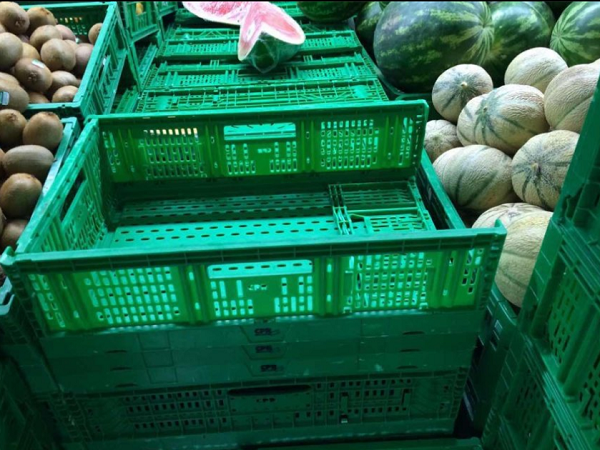
1. Why Don't Specs Tell You Whether a Crate Is Good?
Material is the first real decision point - not because it's the most complicated, but because choosing the wrong one makes every other spec irrelevant.
Every supplier provides a spec sheet, and the numbers often look comparable across products. But buyers who choose on specs alone skip the one question that determines whether the crate will actually perform: does the material suit the conditions it will face?
PP (polypropylene) and HDPE (high-density polyethylene) are the two most common materials in plastic foldable crates, and they behave very differently under real operating conditions.
PP or HDPE - What's the Real Difference?
PP and HDPE aren't interchangeable - they're built for different environments.
PP is lighter and handles higher temperatures better, making it well-suited for retail distribution and lightweight return logistics. HDPE resists impact, moisture, and chemicals more effectively, which makes it the more reliable choice for fresh produce handling, cold chain transport, and outdoor use.
The decision isn't about which material is better. It's about which environment the crate will actually face. A plastic storage crate cycling through a temperature-controlled warehouse has different requirements from one handling field harvests and wet loading docks. Match the material to the environment first, then look at the rest of the spec sheet.
What Happens to the Wrong Material in Cold Chain Conditions?
In cold chain operations, material failure almost always starts at the hinge.
Some materials become brittle below -10°C, and the weakest point is almost always the folding hinge. PP generally maintains structural integrity at lower temperatures than some alternative materials, but exact cold tolerance varies by grade and wall thickness.
If your operation involves refrigerated or frozen flows, ask for the material's temperature rating documentation before committing to an order. A supplier who can't provide this data is giving you a reason to keep looking.
2. Did You Know a Failed Latch Can Write Off the Entire Crate?
Latch failure is the leading cause of early crate retirement, and most guides never explain why.
Nearly every buying guide mentions a "locking system." Almost none explain what type of latch it is, how long it lasts, or why latch failure is the single most common reason foldable plastic crates get retired before they should.
Latch design determines how long a crate stays functional. Matching latch type to operating intensity is not optional.
Are All Latches the Same?
Single, dual, and reinforced latches aren't just different names - they're designed for different workloads.
Single latches hold adequately when crates are folded and unfolded a few times a week under modest loads. Dual-latch systems distribute stress across two contact points, which matters when crates are folded hundreds of times a month by multiple workers under time pressure.
Reinforced latch designs - the kind with an added support component at the closure point - are the right choice when loads regularly approach the crate's rated capacity or when folding plastic crates are used outdoors in variable weather. Choosing the wrong latch type doesn't usually show up in the first month. It shows up six months later, when the first batch starts failing faster than expected.
Static vs Dynamic Load Capacity - Which One Actually Matters?
Suppliers quote static load ratings because they're higher, but dynamic ratings are what matter in transit.
Static load capacity refers to how much weight a crate holds when stacked in a fixed storage position. Dynamic load capacity refers to how much it withstands while in motion - on a forklift, a conveyor, or a delivery vehicle. These two numbers can differ significantly, and suppliers typically quote the static figure.
If your operation is primarily transport rather than warehousing, ask specifically for dynamic load ratings and request the corresponding test documentation. Without it, you're sizing crates against a number that doesn't reflect how they'll actually be used.
How Soon Do Latches Fail - and Can You Tell in Advance?
You can assess latch durability before a bulk order, if you know what to ask for.
Under high-frequency use, lower-quality latches typically begin showing signs of loosening within several hundred fold cycles. The most reliable way to assess this before placing a large order is to request a sample and run a basic fold-stress test yourself.
Any reputable supplier should be able to provide documentation of their folding endurance testing standard. If they can't, that absence is useful information in itself.
3. What Does It Cost When the Crate Size Doesn't Fit?
A wrong size doesn't just mean the crate won't fit - it disrupts every downstream step in your operation.
Selecting the wrong footprint means every downstream step - racking, palletising, forklift clearance, conveyor transfer - runs into the same constraint. Stackable plastic crates are only efficient when they fit the system they're entering.
Crates are logistics system components, not standalone products. Before ordering, confirm that the external footprint aligns with the pallet standard you're using, and verify compatibility with existing racking heights and any conveyor or automated sorting systems.
A distribution centre that standardised on Euro-footprint crates two years ago can't simply introduce a non-standard size without creating handling exceptions at every touchpoint. The cost of that friction - retraining, workarounds, slower throughput - is rarely visible in a unit price comparison but accumulates quickly.
| Crate Footprint | Common Pallet Match | Typical Use Case |
|---|---|---|
| 600 × 400mm | Euro pallet (fits 8 per layer) | Retail distribution, food logistics |
| 400 × 300mm | Euro / GMA (flexible) | Pharmaceutical, small parts |
| 1200 × 800mm | Euro full-pallet size | Bulk storage, industrial logistics |
| 1219 × 1016mm | GMA pallet | North American distribution |

4. Vented or Solid-Wall - Does It Actually Matter?
The vented vs. solid-wall decision isn't just about airflow - cleaning requirements and compliance play an equal role.
"Fresh produce needs vented crates" is correct, but incomplete. Two other factors consistently get overlooked, and either one can make the right-looking collapsible plastic crate the wrong choice for your operation.
The choice between vented and solid-wall depends on three conditions: the type of goods being transported, the handling environment, and the cleaning requirements of the operation.
Cleaning is a more significant operating cost than most buyers account for. Vented crates are harder to clean thoroughly because residue accumulates in the perforations. Solid-wall crates rinse clean more easily and are better suited to operations with strict hygiene protocols.
For operations handling food or pharmaceutical products, the material must also meet food contact compliance standards: FDA approval for the US market, or EU Regulation 10/2011 for European distribution. Compliance documentation should be confirmed before any contract is signed, not after.
5. Does a Cheaper Crate Actually Save You Money?
The unit price is just one input - the real number is what the crate costs per cycle over its full operating life.
A crate priced 20% lower can end up costing more over two years if its failure rate is twice as high. Most buyers make this calculation after the fact, not before.
The real cost of foldable crates has three components: the purchase price, the annual replacement cost driven by failure rate, and the return-trip logistics saving that only folding designs deliver. A lower unit price rarely survives contact with a high failure rate across the full operating cycle.
The return logistics component is the piece most buyers leave out of the calculation. A rigid crate returning empty occupies the same volume as one returning full. A folded crate takes up a fraction of that space, meaning a single return vehicle handles significantly more units per run. For high-frequency distribution networks - such as supermarket replenishment routes or agricultural distribution hubs - this compounds into a measurable freight cost difference over time.
The full cost comparison should include this saving alongside purchase and replacement costs before drawing any conclusion about which plastic crate is actually cheaper. If you're evaluating suppliers, this is also the right moment to request a sample.
6. What Should You Ask a Supplier Before Committing?
Every supplier claims quality - the useful filter is whether they can back that claim up with documentation.
The practical way to separate reliable suppliers from unreliable ones isn't to compare brochures. It's to ask specific questions and see what they can provide in writing.
Before committing to a supplier, verify five things: whether sample quality matches production quality, whether folding endurance test records exist, whether relevant certifications are documentable, how delivery timelines are confirmed after order placement, and whether customisation - colour coding, logo printing, RFID tracking slots - is supported at your required order volume. These aren't premium requests; they're standard asks for any B2B procurement at scale.
What Tests Should You Request Before Placing an Order?
Three tests give you most of the information you need, and any serious supplier should provide all three.
Three tests matter most: a folding endurance test (ask for the testing standard and any available report), a load capacity test that distinguishes static from dynamic conditions, and food contact compliance documentation where relevant.
Any supplier unwilling or unable to provide these should be treated as a risk, not a discount opportunity. A manufacturer with genuine quality control infrastructure will have this documentation ready, because they've already run the tests.
Common Buying Mistakes Worth Avoiding
These mistakes are easy to make and expensive to fix - most of them happen before the order is placed.
Evaluating unit price without accounting for failure rate means the lower-cost option often turns out to be more expensive within twelve months.
Skipping the sample stage on large orders removes the only reliable way to verify that production quality matches what was quoted.
Requesting only static load ratings for crates that will primarily be used in transit leaves a critical performance gap unverified.
Overlooking food contact certification requirements until after delivery creates compliance exposure that can delay or block product launch.
Failing to confirm customisation capabilities - colour coding, logo printing, RFID slots - before signing means discovering the limitation when it's already too late to change suppliers.
Conclusion
Choosing the right foldable plastic crate doesn't require becoming a packaging specialist. It requires asking the right questions across six areas: material, latch structure, dimensions, application type, total cost, and supplier reliability.
If you're at the sourcing stage, the most practical next step is to request samples before committing to volume. A reliable supplier will support that request without hesitation.
