


How 48x40 Rackable Plastic Pallets Became The Backbone Of Modern Warehousing?
If your warehouse is still running on wood pallets, you've probably felt the cost of that decision more than once - broken boards, failed racking loads, or a failed FDA inspection that no one saw coming. The question isn't whether to upgrade. It's whether you're choosing the right pallet to replace them with.
48x40 rackable plastic pallets are the most widely used pallet format in North American warehousing because they satisfy three requirements at once: they match the GMA-standard footprint, they hold rated loads on unsupported rack beams, and they meet hygiene requirements that wood simply can't. No other pallet size and construction combination covers as much ground.
Most buyers come to this topic knowing they need "the standard pallet" but unsure whether plastic is worth the price difference, or how to tell a genuinely rackable pallet from one that just claims to be. This article walks through both questions - starting with why the 48x40 footprint became standard in the first place.
Why Is 48x40 the North American Standard - and Does It Actually Matter?
The 48x40-inch dimension isn't just industry habit. It's the result of a specific engineering fit that makes it work across storage, racking, and transport at the same time.
The 48x40 pallet size was formalized by the Grocery Manufacturers Association - now called the Consumer Brands Association - as the standard warehouse pallet in the United States. Standard selective pallet rack frames, the most common racking system in North American warehouses, are built with a 42-inch depth.
A 48-inch pallet placed lead-edge-first across those beams leaves roughly 3 inches of overhang on each side. That's not a coincidence - it's the range considered stable enough to prevent tip-off but short enough to maintain load integrity under weight.
The transport math works out just as cleanly. A standard 53-foot dry van trailer fits 26 pallets in straight-row loading and up to 30 pallets in a pinwheel configuration. Those numbers only work because 48x40 was designed around trailer interior dimensions from the start.
Choosing a non-standard pallet size doesn't just create warehouse compatibility issues - it often means fewer pallets per truck and higher per-unit freight costs.
If you're planning a new facility or re-evaluating your current pallet spec, this size gives you access to the widest range of compatible racking hardware, the lowest cost on standard rack components, and the most flexibility in carrier selection. Research suggests that optimizing pallet sizing alone can increase effective warehouse storage capacity by 15 to 30 percent - without adding a single square foot of floor space.
What Does "Rackable" Actually Mean - and How Do You Verify It?
The word "rackable" appears on almost every plastic pallet listing, but it means nothing without a specific number attached to it.
A rackable pallet is defined by its ability to support a rated load while suspended across rack beams with no surface underneath - what the industry calls an unsupported span or open span condition. The number that reflects it is called the racking load capacity, which is separate from - and almost always lower than - the two other load figures you'll see on spec sheets.
Here's how the three load ratings actually break down:
| Load Type | What It Measures | Typical Range |
|---|---|---|
| Static Load | Pallet sitting still on a flat surface or stacked | 10,000–30,000 lbs |
| Dynamic Load | Pallet being carried by a forklift in motion | 2,000–5,000 lbs |
| Racking Load | Pallet suspended on rack beams, unsupported | 1,500–2,800 lbs |
The racking load is the one that determines whether a pallet is safe in your racking system. A pallet with a 30,000 lbs static rating can still fail at 1,800 lbs in a rack if the runner geometry or material isn't designed for unsupported span stress. When comparing suppliers, lead with racking load - not the impressive-looking static figure.
The reason injection-molded plastic pallets perform better in racking comes down to precision. High-pressure injection molding controls wall thickness at specific points - runners, perimeter ribs, beam contact zones - where unsupported load stress concentrates. That's what prevents the bow or deflection you'd see under load with a lower-quality pallet.
Open Deck or Solid Deck - Which Do You Actually Need?
The deck style affects more than just airflow - it changes how the pallet performs in your specific environment.
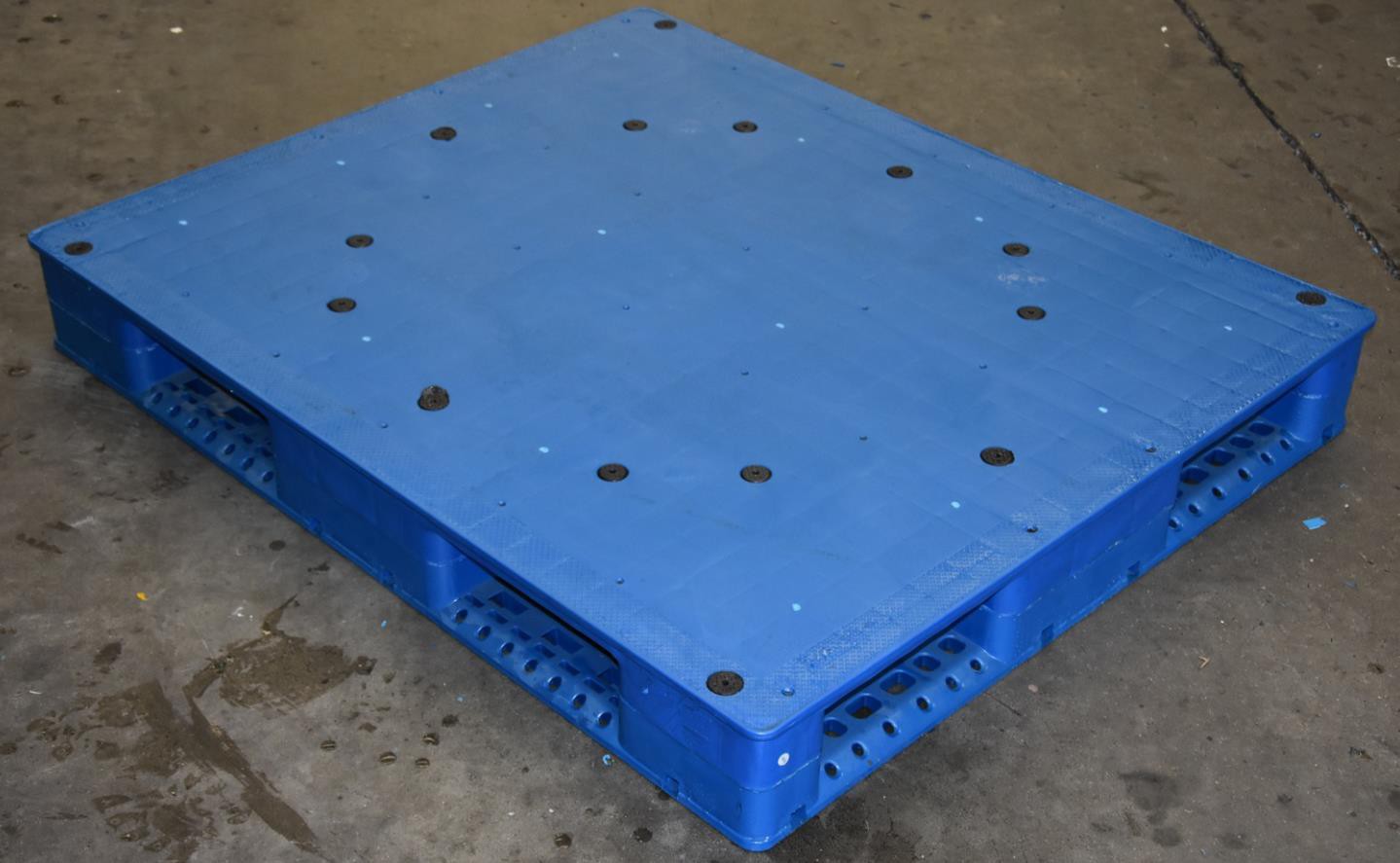
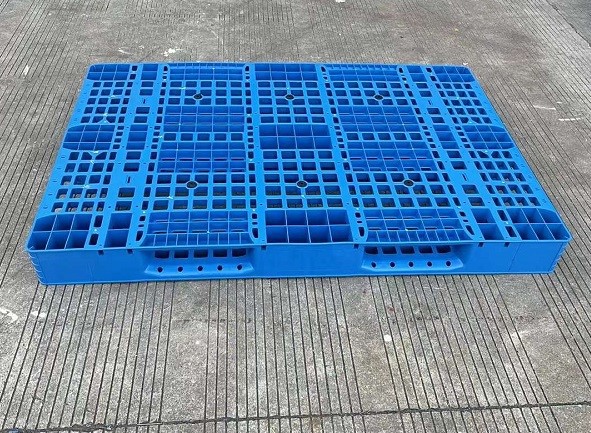
An open deck has a perforated or vented surface. Liquid drains through, air circulates, and cleaning is faster and more thorough. If you're running a food processing facility, cold storage, or any environment where moisture or contamination is a real concern, open deck is usually the right call.
A solid deck gives you an uninterrupted load surface. It's better for small-piece goods that could drop through gaps, or for pharmaceutical cleanroom environments where the goal is containment, not drainage. The trade-off is slightly higher pallet weight and more surface area to sanitize.
One thing to watch: racking load capacity can differ between deck styles from the same product line. Don't assume - check the spec sheet for the specific model, not just the product family.
How to Tell Whether a "Rackable" Pallet Is the Real Thing
Three questions separate a genuinely rackable pallet from one that's just labeled that way.
- First, does the spec sheet list a specific racking load value - in pounds or kilograms - for the unsupported span condition? If it only says "rackable" with no number, that's a claim, not a specification.
- Second, does the documentation specify the test conditions? A racking load figure is only meaningful if it reflects open-span testing, not a floor-supported scenario.
- Third, is there a third-party test report available? Labs like the Virginia Tech Center for Packaging and Unit Load Design run standardized pallet tests. If a supplier can't point you to one, ask why.
Is the Higher Price of Plastic Pallets Actually Worth It?
The purchase price is the easiest number to compare - but it's also the least useful one for making this decision.
Wood pallets cost less upfront. That's true and it's not going to change. But the total cost of ownership across a five-year period tells a different story for most warehouse operations.
Plastic pallets last 8 to 15 years under normal warehouse cycling. Wood pallets typically need replacement within 3 to 5 years, and each repair costs around 20 percent of the original purchase price. Over multiple repair cycles, that adds up faster than most buyers account for when they're looking at line-item costs.
Weight is another factor that's easy to overlook. A plastic rackable pallet typically weighs between 15 and 30 lbs. A standard wood pallet runs 35 to 40 lbs. In a high-volume operation moving hundreds of pallets per week, that difference translates into real freight savings - especially for operations shipping by weight-based LTL rates.
For export-focused operations, there's another cost that wood pallet users absorb that plastic users don't: ISPM-15 compliance. Wood pallets used in international shipping must be heat-treated and stamped to meet phytosanitary standards. Plastic pallets are exempt by default - no treatment fees, no certification delays, no risk of customs holds over documentation.
The honest caveat: plastic pallets make the most financial sense in a closed-loop operation - meaning your pallets come back and get reused. If your model is one-way shipping where pallets don't return, the lower upfront cost of wood may still be the practical answer. But for any operation where pallets cycle through a fixed facility, the TCO math consistently favors plastic.
Which Industries Actually Depend on These Pallets?
A few industries have effectively moved past the wood-versus-plastic debate - because their compliance requirements made the decision for them.
Food and beverage, pharmaceutical, and cold chain logistics are where 48x40 rackable plastic pallets are essentially the standard now. The shared driver is regulatory: FDA and USDA requirements for food-contact and pharmaceutical environments demand surfaces that can be thoroughly sanitized, don't absorb moisture, and won't shed material into the product environment. Wood fails on all three counts. Plastic passes.
Does Performance Hold Up in Cold Storage?
Low-temperature environments are where material choice stops being a preference and starts being a safety question.
Co-polymer polypropylene - the material used in most quality rackable plastic pallets - retains structural integrity at temperatures as low as -30°C. It doesn't become brittle or crack under blast freezer conditions. Wood, by contrast, absorbs ambient moisture before it freezes, and that moisture expansion warps the boards and degrades the structural contact points on your rack beams.
In a cold chain operation, a warped pallet on a rack beam is a load stability problem, not just a maintenance issue. For any operation running blast freezers or low-temperature controlled storage, material selection is a rack safety decision.
Are They Compatible with Automated Systems?
If you're running conveyors, pick systems, or any warehouse automation, pallet consistency isn't optional.
Injection-molded plastic pallets have dimensional tolerances controlled at the millimeter level - meaning every pallet in a batch is effectively the same size. That matters for conveyor rail alignment, automated guided vehicle pickup points, and WMS scan accuracy. Many 48x40 rackable plastic pallets also include two pre-built RFID tag slots, which means you can integrate asset tracking without modifying the pallet.
On the sustainability side: as more retailers and brand owners build ESG metrics into their supplier requirements, the 100% recyclability and longer service life of plastic pallets gives procurement teams a measurable supply chain sustainability argument. For some supplier relationships, it's starting to become a qualification criterion.
How Do You Choose a Supplier You Can Actually Trust?
With hundreds of rackable plastic pallet suppliers offering nearly identical spec sheets, the real differentiator isn't the product page - it's what happens when you ask harder questions.
The five things worth verifying before committing to a supplier:
Raw material type is clearly stated (virgin PP vs. recycled material)
Third-party load test reports are available from a recognized lab
Dimensional tolerances are documented
The after-sales support process is defined and responsive
Traceable references from similar operations are available
That first point - raw material - matters more than most buyers realize.
Virgin PP or Recycled Material - Why It Changes Everything
This one question can explain a 3x price gap between two pallets with identical spec sheets.
Virgin polypropylene is unprocessed material with intact polymer chains. It performs predictably under repeated load cycles, and its structural properties are consistent from batch to batch. Recycled or regranulated material has been through at least one processing cycle, which degrades the polymer chains and reduces actual load-bearing capacity - even when wall thickness appears identical on paper.
Under normal floor storage, the difference might not be obvious. Under racking load conditions over months of use, it becomes a real reliability issue. When evaluating rackable plastic pallet manufacturers - particularly from factories in China, where the market ranges from budget-tier to premium - ask specifically for the material spec sheet, not just the product data sheet. How a supplier responds to that request tells you more about their operation than any product photo.
New Pallets or Reconditioned - Which Makes More Sense?
The answer depends on two things: your hygiene requirements and whether your pallets cycle back to you.
Reconditioned pallets are used pallets that have been inspected, repaired where needed, and re-tested to meet load standards. They typically cost 30 to 50 percent less than new. For a closed-loop, non-hygiene-sensitive operation - general distribution, manufacturing, automotive parts - reconditioned pallets are a legitimate cost-reduction option and are widely available from established suppliers.
For food, beverage, or pharmaceutical operations, reconditioned pallets introduce a traceability gap: you can't verify where they've been or what they've carried. In those environments, new pallets are the safer and more defensible choice. Whatever grade you choose, always request load test documentation for the specific production batch - not just the general product certification that appears on every supplier's website.
Conclusion
Most purchasing decisions around 48x40 rackable plastic pallets come down to the same three sticking points: whether the racking load spec is real, whether the material holds up over time, and whether the supplier can back up their claims with documentation.
If you're sourcing at volume - whether you're a distributor building out a warehouse program, a brand owner standardizing your logistics packaging, or a facility manager replacing an aging wood pallet fleet - getting those three answers right upfront saves significantly more than any unit price negotiation later.
If you'd like to discuss specifications, request load test data, or get a quote for your operation, reach out directly. Most questions can be answered within one conversation.
