


What is the heat resistance of spill plastic pallets?
When it comes to the storage and transportation of hazardous or spill - prone materials, spill plastic pallets play a crucial role. These pallets are designed not only to support the weight of the goods but also to contain any spills that may occur, preventing environmental contamination and ensuring workplace safety. One important aspect that often gets overlooked is the heat resistance of spill plastic pallets. As a spill plastic pallet supplier, I'd like to delve into this topic to help our customers make more informed decisions.
Understanding the Basics of Heat Resistance
Heat resistance refers to a material's ability to withstand high temperatures without significant degradation in its physical and mechanical properties. For spill plastic pallets, this is of utmost importance, especially when they are used in environments where they may be exposed to heat sources such as direct sunlight, industrial ovens, or hot machinery.
The heat resistance of a spill plastic pallet is determined by the type of plastic used in its manufacturing. Common plastics used for these pallets include high - density polyethylene (HDPE), polypropylene (PP), and others. Each of these plastics has different heat - resistant characteristics.
HDPE is a popular choice for spill plastic pallets due to its excellent chemical resistance and relatively good heat resistance. It can typically withstand temperatures up to around 60 - 80°C (140 - 176°F) without significant deformation. However, prolonged exposure to temperatures at the upper end of this range may cause some softening, which could affect the pallet's structural integrity over time.
Polypropylene, on the other hand, has a higher melting point compared to HDPE. It can generally tolerate temperatures up to about 100 - 120°C (212 - 248°F). This makes it a better option for applications where the pallets may be exposed to moderately high temperatures. But like HDPE, continuous exposure to high temperatures can still lead to long - term degradation.
Factors Affecting Heat Resistance
Several factors can influence the heat resistance of spill plastic pallets:
1. Additives
Manufacturers often add various additives to the plastic during the production process to enhance its heat resistance. For example, heat stabilizers can be used to prevent the plastic from breaking down at high temperatures. These additives can significantly improve the pallet's ability to withstand heat, but the effectiveness depends on the type and amount of the additive used.
2. Wall Thickness
The thickness of the pallet's walls also plays a role in its heat resistance. Thicker walls can provide better insulation and are less likely to deform quickly under high - temperature conditions. A spill plastic pallet with thicker walls will generally have better heat - resistant properties compared to one with thinner walls.
3. Design and Structure
The design of the pallet can affect how it dissipates heat. Pallets with a more open or ventilated design may be able to release heat more effectively, reducing the risk of heat buildup and subsequent damage. In contrast, pallets with a closed - in design may trap heat, leading to higher internal temperatures and potentially faster degradation.
Applications and Heat Resistance Requirements
The heat resistance requirements for spill plastic pallets vary depending on their applications:
1. Outdoor Storage
When used for outdoor storage, spill plastic pallets are exposed to direct sunlight, which can raise their surface temperatures significantly, especially in hot climates. In such cases, pallets with good heat resistance are essential to prevent warping and cracking. HDPE pallets are often sufficient for most outdoor applications, but in extremely hot regions, polypropylene pallets may be a better choice.
2. Industrial Settings
In industrial environments, spill plastic pallets may be exposed to heat from machinery, ovens, or other industrial processes. For example, in a chemical manufacturing plant, pallets used to store chemical drums may be near hot reaction vessels. In these situations, pallets with high heat resistance are necessary to ensure their long - term performance and safety.
3. Food and Beverage Industry
In the food and beverage industry, spill plastic pallets may be used in areas where they are exposed to warm temperatures during processing or storage. Heat - resistant pallets are important to maintain the integrity of the pallets and prevent any contamination of the food products.
Our Product Range and Heat Resistance
As a spill plastic pallet supplier, we offer a wide range of products to meet different heat - resistance requirements.
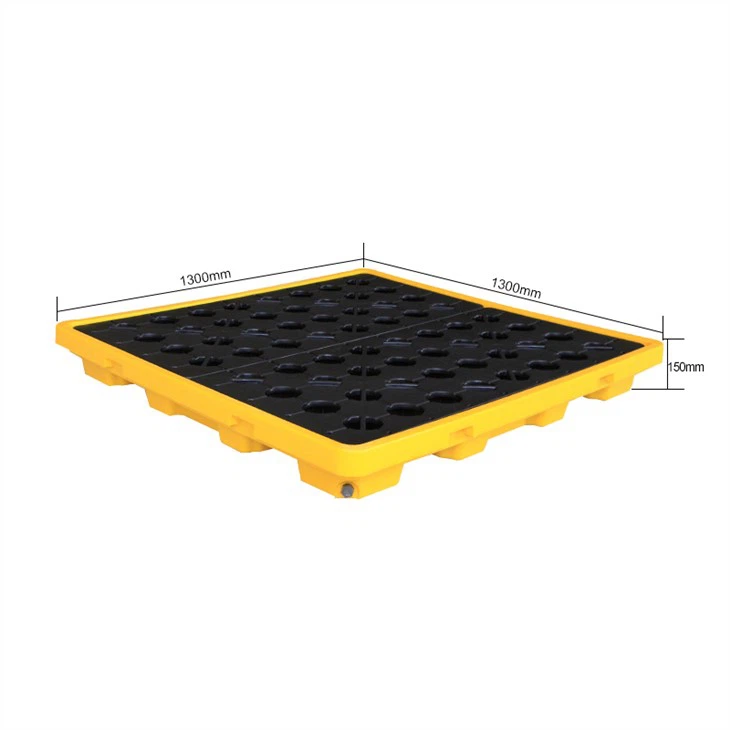

Our Single IBC Spill Containment Bund is made from high - quality HDPE. It is designed to withstand normal outdoor and indoor temperature variations. The walls of this bund are thick enough to provide good insulation and prevent heat - related deformation. This product is suitable for storing single Intermediate Bulk Containers (IBCs) in various environments.
For customers who need to store multiple drums, our 4 Drums Spill Containment is an excellent choice. It is available in both HDPE and polypropylene options. The polypropylene version offers higher heat resistance, making it ideal for industrial settings where higher temperatures may be encountered.
Our 2 drum spill containment pallet is also available in different plastic materials. Whether you need a pallet for general storage or for use in a moderately high - temperature environment, we can provide a suitable solution.
Testing and Quality Assurance
To ensure the heat resistance of our spill plastic pallets, we conduct rigorous testing. Our pallets are tested in temperature - controlled chambers to simulate different heat - exposure scenarios. We measure the pallets' physical properties such as dimensions, hardness, and strength before and after the heat - exposure tests. Only pallets that meet our strict quality standards are released to the market.
Choosing the Right Spill Plastic Pallet Based on Heat Resistance
When choosing a spill plastic pallet based on heat resistance, customers should consider the following:
1. Temperature Range
Determine the maximum temperature the pallet will be exposed to in its intended application. If the temperature is relatively low, HDPE pallets may be sufficient. But for higher - temperature applications, polypropylene pallets are recommended.
2. Duration of Exposure
Consider how long the pallet will be exposed to high temperatures. Prolonged exposure to high temperatures will require a pallet with better heat - resistant properties.
3. Budget
Polypropylene pallets generally cost more than HDPE pallets due to their higher heat - resistant capabilities. Customers need to balance their heat - resistance requirements with their budget.
Conclusion
The heat resistance of spill plastic pallets is an important factor that should not be overlooked. As a spill plastic pallet supplier, we understand the diverse needs of our customers and offer a range of products with different heat - resistant properties. Whether you need a pallet for outdoor storage, industrial use, or in the food and beverage industry, we can provide a suitable solution.
If you are interested in our spill plastic pallets and would like to discuss your specific requirements, we encourage you to contact us for a detailed consultation. Our team of experts is ready to assist you in choosing the right pallet for your application.
References
- "Plastics Engineering Handbook", Edited by Myer Kutz, Wiley - Interscience
- "Polymer Science and Technology", Second Edition, by Robert J. Young and Peter A. Lovell, Chapman & Hall
